The Craft Behind the Camera
Leather Costume Craft


Why leather and the skills of the leatherworker remain a central part of contemporary costume production.
Words by Tom Bottomley
The King’s Foundation is preparing to take on the second cohort of students for its Amazon MGM Studios supported Costume Craft Programme, following on from its successful inaugural nine-month course completed by eight selected students in May 2026.
Skilled leatherwork for costumes on film, TV and stage is an important part of the programme, and some students excelled for their final projects by creating real works of costume art with leather. What’s more, it was the part of the course that many loved the most. Good news for future productions seeking the next generation of skilled leather costumers.
Of course, leatherwork and costumes for film, TV and stage have long been entwined, particularly for period productions where intricate details are key, as one such celebrated worker in the field, Rob Goodwin, will testify. His latest film work has included making a detailed leather piece for actor Tom Holland in his role as Telemachus for the recently released blockbuster The Odyssey, but more on that later.
With such leatherwork skills increasingly being lost to each new generation, it’s timely that The King’s Foundation and Amazon MGM Studios, with partners like The Leathersellers’ Foundation, have stepped in to provide support for talented craftspeople who are eager to learn from the best with a view to carving a career in costume.
The King’s Foundation is King Charles’ nature and sustainability charity and is based at Dumfries House in Ayrshire, Scotland. As part of its work to build and promote sustainable communities, the Foundation support learning and education at all levels, with a strong focus on heritage crafts and sustainable practices – all in line with His Majesty’s environmental vision. Its postgraduate programmes are fully funded and many have cost of living bursaries attached to them.
Costume Craft Programme Lead, Carys Hobbs, who has also been a costume designer in the industry for about 15 years, says: “Amazon had approached us about establishing a course specifically looking at getting younger members of the industry trained in film and TV, but also to specialise in crafts that are dying out, or have an ageing population of people who can do all the different skills such as leatherwork, embroidery, tambour beading and natural dyeing.
“The King’s Foundation partnered with Amazon MGM Studios during the filming of Finding Harmony with his Majesty, which whilst being filmed on the Dumfries House Estate led to the emergence of an education partnership between the organisations and the creation of the Costume Craft Programme; allowing for recent graduates to specialise in learning heritage crafts that have a waning working population.
“We looked for potential students who had received basic training in the fashion or costume industry in the degree format, but most importantly those who had a real passion for craftsmanship.
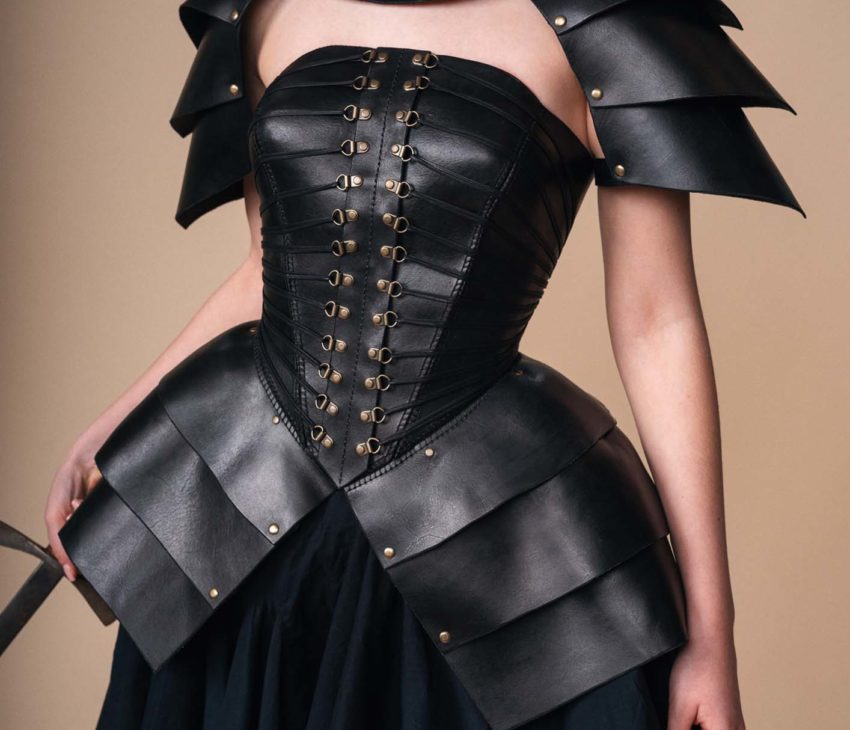
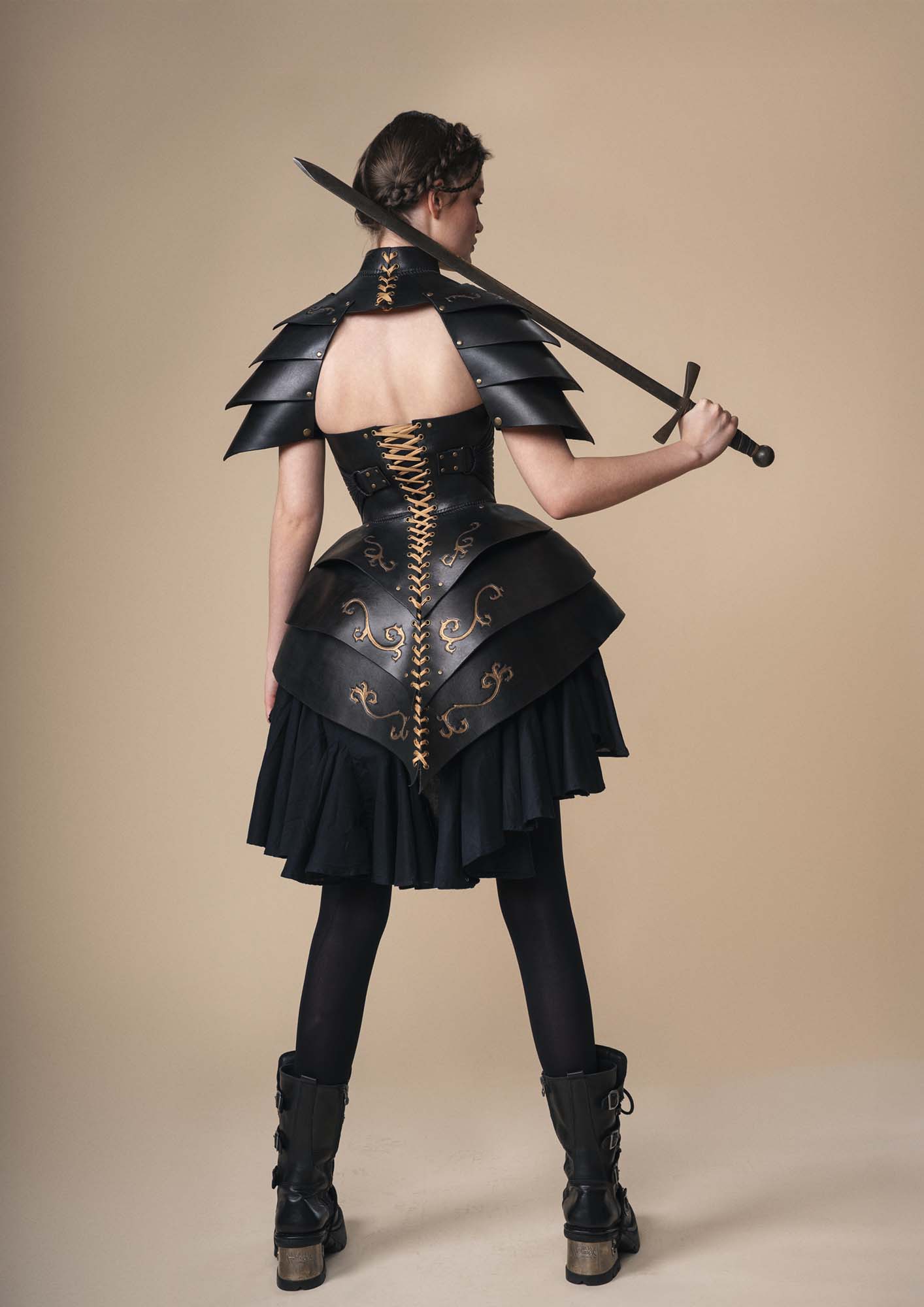 Costume by Ava Harker
“I made a leather costume inspired by Mary I in My Lady Jane, drawing inspiration from historical portraits of Mary as well as men’s armour from that period. I combined the two into a form of Tudor power dressing.”
“The students had the opportunity to take part in a series of master classes and then their final project was to focus on one area. The Leathersellers’ Foundation funded most of these classes for the students to really give them a proper education in leather and how it can be sustainable. It was also about learning how its properties are so uniquely useful for film and TV in that it’s very durable, you can mould it and it’s very wearable. Some of the students really got into it and focused on leather for their final pieces.”
The students were taken to Cotmarsh Tannery on Great Cotmarsh Farm near Swindon, a new micro-tannery striving to produce highly traceable veg tanned cattle leather. They also spent a day with British Pasture Leather, a business in north London run Alice Robinson (a member of the Leathersellers) and Sara Grady who are very passionate about working on the sustainable chain of leather – starting with the farming of cattle and sheep.
“We then had two tutors from The Northern School of Art who work with what’s called leather wet moulding, showing how you can wet the leather and then hold it over a solid form so it takes its shape,” says Hobbs who, along with supporting the students through the course, said she actually learned more in-depth knowledge in the craft from the experts herself too.
“It’s a skill that is used widely in film and TV. Some of our students made leather torsos held over mannequins for instance, creating really form-fitting items using wettened veg tan leathers. You just let it dry in shape, which you can’t do as successfully with chrome tanned leather because it has a chemical resistance to holding a form.
“There’s also a lot of tooling you can do into veg tan leather, using small metal stamps to create very detailed shading and patterns on leather. The students had a great schooling in that.”
Another “incredibly intensive” master class came from a visit to Thomas J. Rowe, who owns a company called Footwear for Film based in North London, where the students were given insights into how shoes are patterned and what elements of the leather grain can be used.
Student Ava Harker had just completed a degree in Costume for Theatre, TV and Film at Bristol Old Vic Theatre School and was keen to broaden her experience. Hence, she was extremely happy to be accepted as part of the inaugural cohort for The King’s Foundation Costume Craft Programme last September.
“I’ve always been fascinated by heritage crafts and folk traditions such as Gansey knitting and straw-work, so the idea of spending nine months adding to that repertoire of skills was really exciting,” says Harker.
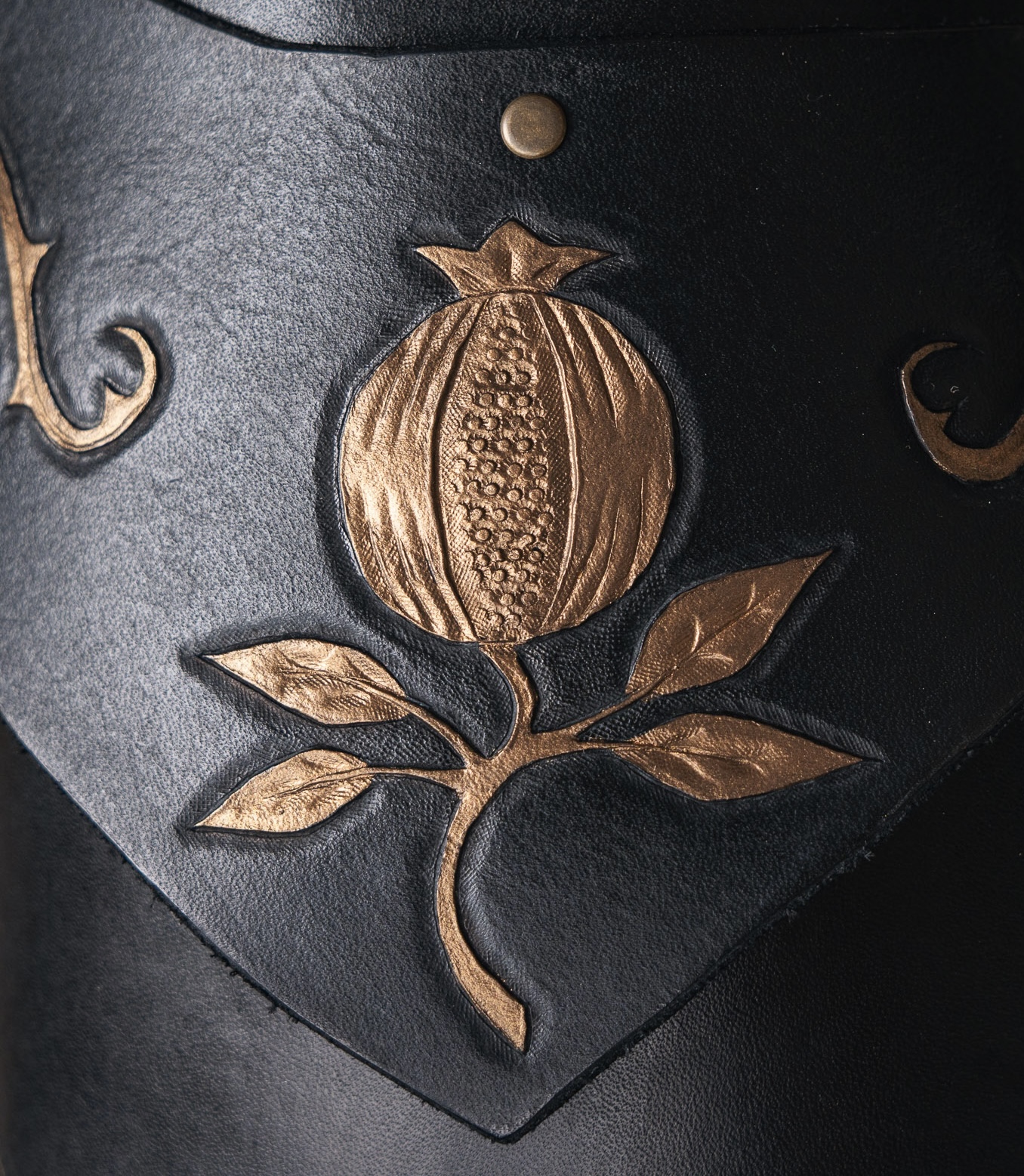 Wet moulded leather with hand tooled pomegranates and Tudor roses.
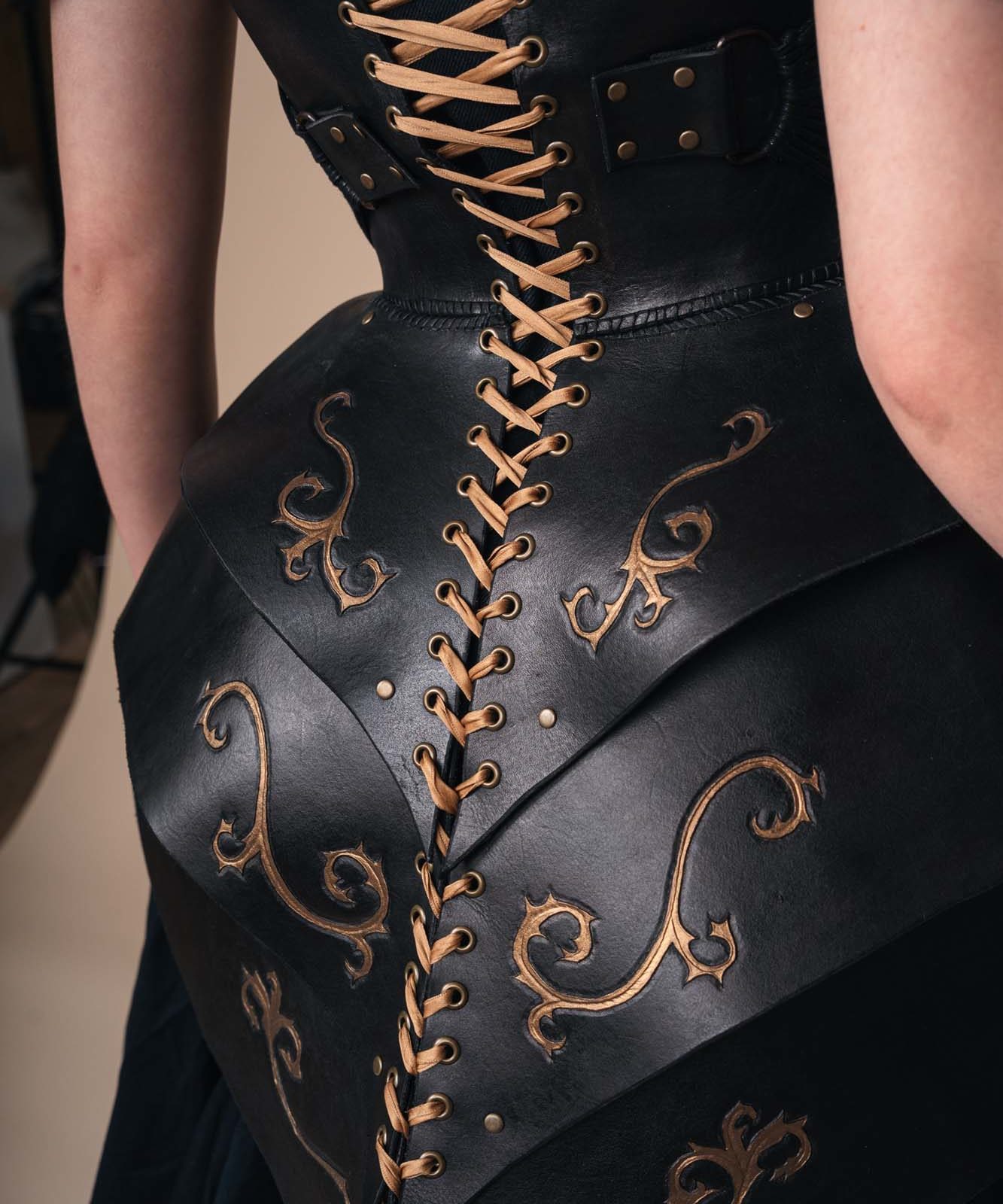
“I’d never seen a course that linked heritage crafts with film and TV costume before, and I was interested in how the two could be combined. It’s also so rare to have a course that’s fully funded, including materials, as heritage crafts can have a high ‘start up’ cost due to using unusual or highly specialised tools and materials. The course was a once in a lifetime opportunity to try out lots of different heritage crafts with no pressure or financial risk.
“The leatherwork master class was definitely my favourite. We were based at the Northern School of Art for it and had access to their incredible facilities and tools. Once I tried leather tooling, I was very keen to explore all the possible textures I could create and how they could be incorporated into costumes.”
The course deepened Harker’s appreciation for natural materials and heritage crafts, while placements on Amazon MGM Studios productions provided a real insight into how such crafts can fit into different aspects of a modern costume department.
Fellow graduate George Wright was equally impressed with the Costume Craft Programme, having already worked in TV but not on the costume-making side, which attracted her the most.
She had heard about the course through her supervisors on her last television job. The advert for it had also gone around a few costume related group chats. She was attracted to the course as she’d had very few opportunities to make costumes since leaving university.
“While I have been working in costume, I’ve only managed to break into the office and set side of the business rather than the making rooms,” says Wright.
“I really loved the leatherwork side of the course as it was something I had always wanted to try but had never the opportunity or the funds to try independently. The King’s Foundation really set us up as we had talks with companies such as British Pasture Leather, Billy Tannery and the Leather Conservation Centre, as well learning with the Northern School of Art.
“That’s where we covered the pros of using vegetable tanned leathers; the need for sustainable farming and how it applies to every step of our creations; as well as the historical uses of leather that we could follow and adapt to create some really wonderful things.
“I absolutely love working with leather, particularly vegetable tanned leathers. It’s so useful for so many different purposes and, as someone who loves the tactile side of crafting, it’s on a whole new level.
“It’s definitely more useful for us as costumers, especially given that the industry commonly uses leather for armour as it can be painted to look like metal while keeping actors more comfortable. It’s also great for creating high levels of detail.”
The students’ final projects were to reimagine the costumes in Prime Video’s My Lady Jane, Malice and The Rig. Wright says she was already a big fan of the show My Lady Jane, particularly the soundtrack, which also reimagines many classic rock songs from the late 1960s to 1970s.
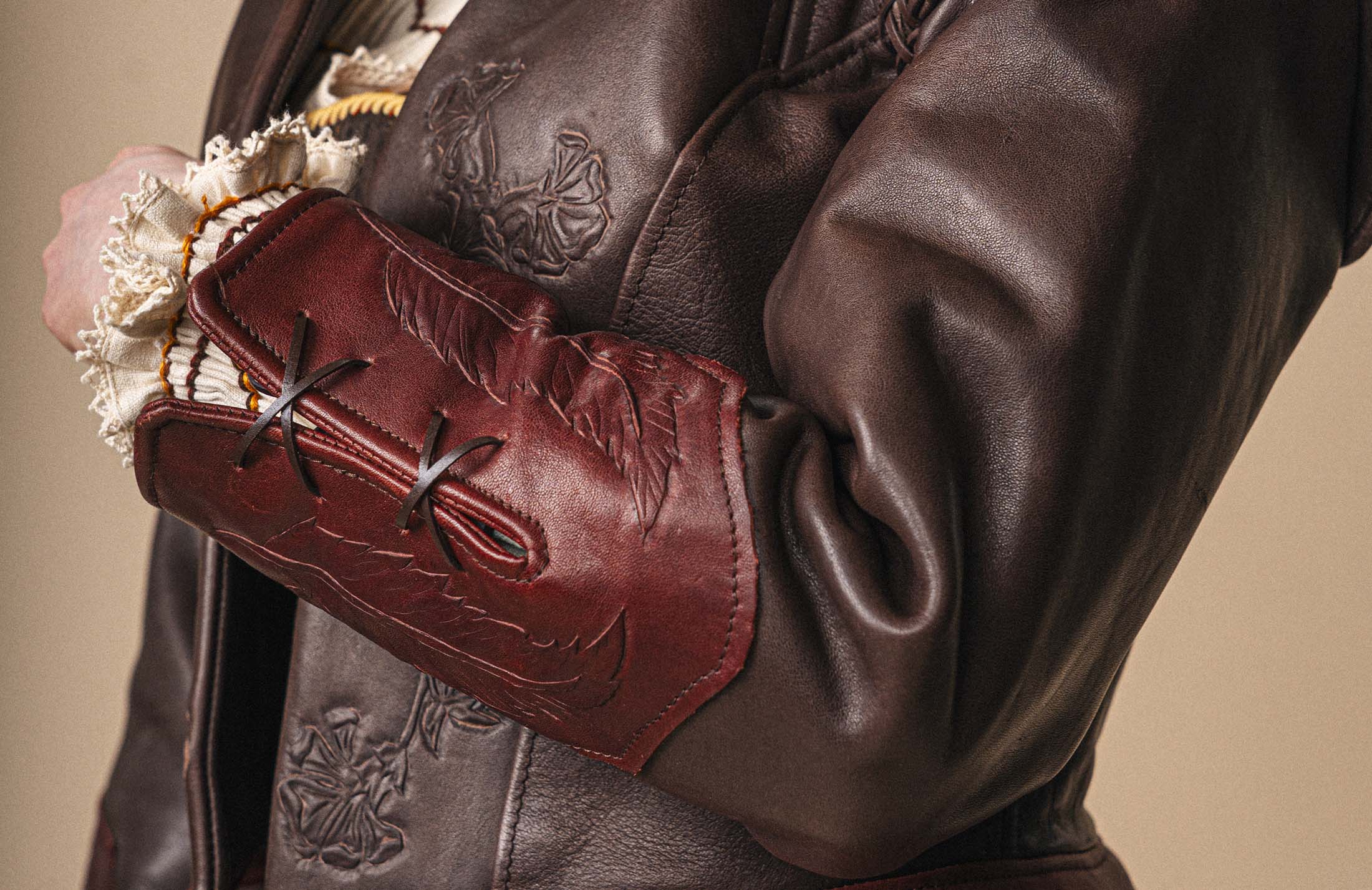
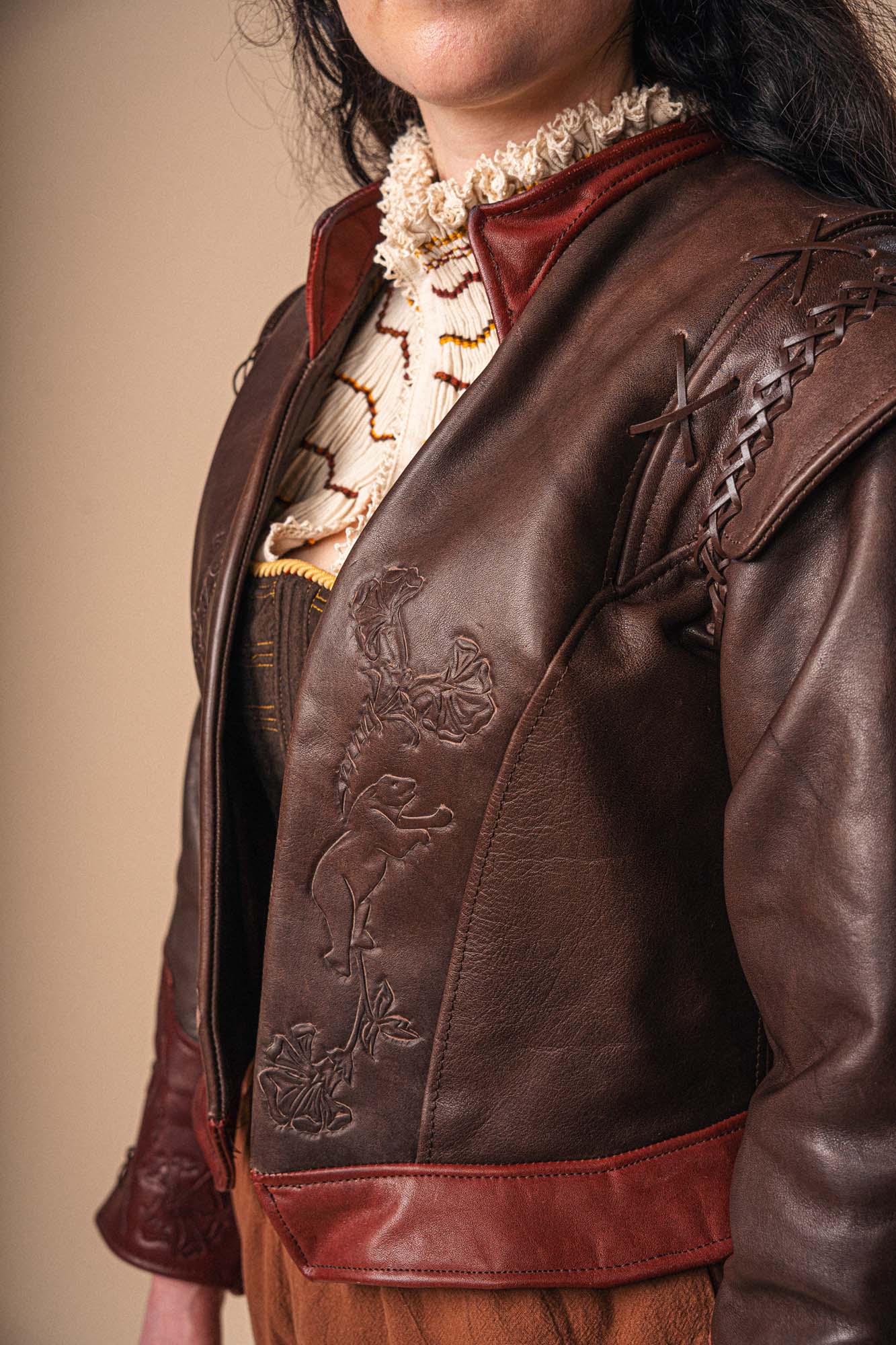 Costume by George Wright
“I used those silhouettes and mixed them with those of the Tudor times to create a rock and roll aesthetic that fitted in with the music, using the imagery of the animals and wildlife from the show for the tooling designs.”
“I took inspiration from those bands, especially the leather jackets they were wearing, some from the East West Musical Instruments Company, which are works of art. I used those silhouettes and mixed them with those of the Tudor times to create a rock and roll aesthetic that fitted in with the music, using the imagery of the animals and wildlife from the show for the tooling designs.
Harker says the students were given scripts from several Amazon MGM TV shows with free rein to design and make for a character of their choice for their final pieces. “I made a leather costume inspired by Mary I in My Lady Jane, drawing inspiration from historical portraits of Mary as well as men’s armour from that period. I combined the two into a form of Tudor power dressing.
“I wet moulded the leather to create an exaggerated silhouette and hand tooled pomegranates and Tudor roses across the chest and shoulders to represent Mary 1st’s royal lineage.”
Wright had kept in contact with Alice Robinson and Sara Grady from British Pasture Leather, who advised her on which of their leathers would be most suitable for her final piece. “Usually when tooling you use very firm, unmilled leather, but I wanted to push the boundaries on this as I really enjoyed how light and soft the thinner, milled leather was,” she says. “I wanted to create a softer garment than the armour it’s usually used for. Luckily, after many test runs, it all worked out.”
In the original session with the Northern School of Art, Wright says they were provided with a whole range of cutting, bevelling and stamping tools to experiment with. “It was amazing to see how we were all taught the same techniques but went in such different directions.
“Following the course, I’m going back into the industry with a renewed passion for making that I had put aside while trying to get into TV and film, and I’m trying to contact as many workroom professionals as I can, especially those in the craft specific rooms.
“We also had the opportunity to go on placements with Amazon MGM Studios on a few of their projects, so we had the opportunity to meet so many lovely makers who were very generous with their teaching and gave us their contact details, so that will hopefully be a great way of breaking in.”
Carys Hobbs believes there is still very much a demand for skilled leatherwork for film and TV. “Every time you see a big production come around, such as The Lord of the Rings: The Rings of Power and any of the big period pieces, there’s always a demand for leatherwork. Even down to the Marvel films which use leather a lot for head pieces, body suits and armour.
“While there has been a notable push towards some 3D printing for some things that used to always be leather, the majority of people understand that leather is more comfortable for actors to wear and it just moulds to your body a lot more, whereas 3D printing can be a bit harsh.
“One of the best examples of leatherwork in film I can think of would be the first Gladiator film from 2000 starring Russell Crowe and Joaquin Phoenix, which had very beautiful and intricate leather armour created for all of the principal characters. When you look up close, it’s absolutely stunning, a real craft.
“Later down the line in the franchise with Gladiator II (2024), I’ve been told a lot of the armour for the extras was produced using 3D printing, but the main cast members I believe still wore leather pieces.
“People work an incredibly long time to forge careers in leatherworking and it’s not easily accessible for younger people to necessarily find their way into it without the support of organisations such as The Leathersellers.”
One such leather costume maker who has really been making a mark of late is Rob Goodwin. As aforementioned, Goodwin made a piece for actor Tom Holland in his role of Telemachus in the recently released epic fantasy film The Odyssey, an adaptation of Homer’s ancient Greek epic poem of the same name. So far, it’s the biggest film release of 2026 and Goodwin’s creation features in the dramatic final scene.
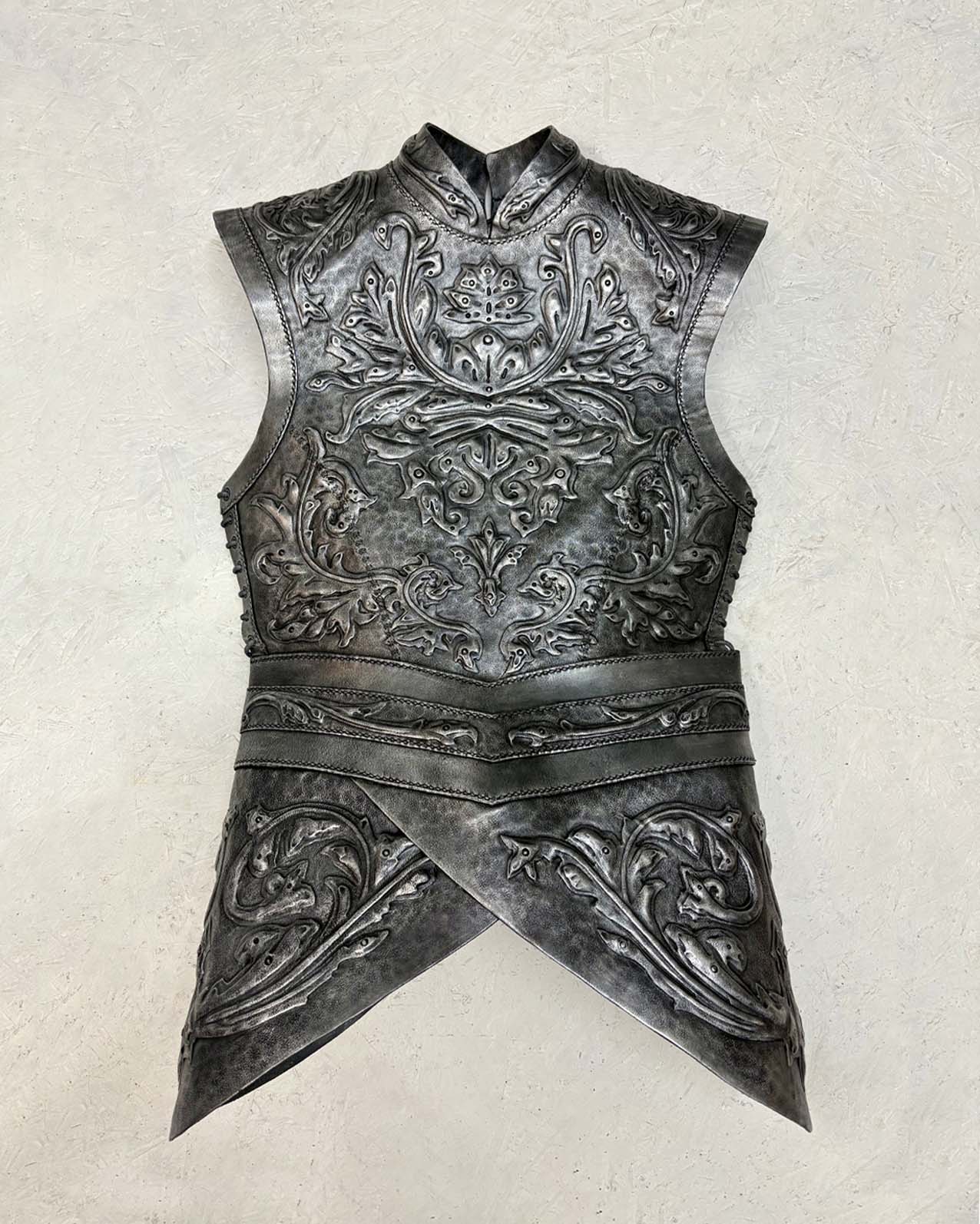 The Odyssey: Year 2026; Head Designer: Ellen Mirojnick; Christopher Nolan/Universal Pictures.
His break into creating leather pieces for film came after some work he did for the English National Ballet’s production of The Firebird, for which he created a plumed leather headpiece and a winged harness for the main female character, as well as a headpiece and plumed cuffs for the male lead.
“That all culminated in a fateful email I received in 2012 which informed me that Angelina Jolie had seen my work and wanted to invite me to work on her latest film Maleficent. That’s how and when my career in film costume truly began,” says Goodwin.
Having been working in broadcast TV as a VT operator, editing and playing video clips in chat shows and cookery shows, it was in his mid-30s that Goodwin says he realised he probably had one last realistic chance “to take control” and switch to a more creative career – which he’d always dreamt of.
“I initially considered learning tailoring but wasn’t sure I’d enjoy managing the clientele,” he explains. “So, rather surprisingly, I settled upon learning shoemaking and enrolled on a part-time course at London College of Fashion in 2006.
“I took to it immediately and had early success: one of my first pairs of shoes that I designed and made were used in a photoshoot for UK Vogue, and a stylist for a subsequent shoot for Italian Vogue asked if I had any headwear which would feature more prominently in the photographs.
“I quickly moved my cordwaining skills up the body and into millinery. These extra-curricular commissions occurred throughout my subsequent MA and, after graduating in 2010, I was regularly asked to create more leatherwork to be worn on foot, head or body, for magazines and commercials. That led to the work for The Firebird ballet production, and subsequently the work on Angelina Jolie’s Maleficent.”
Goodwin later worked with renowned costume designer Ellen Mirojnick on the sequel, Maleficent: Mistress of Evil, again starring Angelina Jolie. It was through working with Mirojnick that he was contacted to do a piece for The Odyssey.
“I knew it would be a big film because she’s amazing and quite a legend in Hollywood, so I jumped at the chance. Around that time I had a flurry of work offers and I also went to work on Dune: Part Three in Budapest as a senior costumer prop. It was Dune by day and Odyssey by night! They are the two big films this year really, with the Dune film being released this winter, so both good for my CV.”
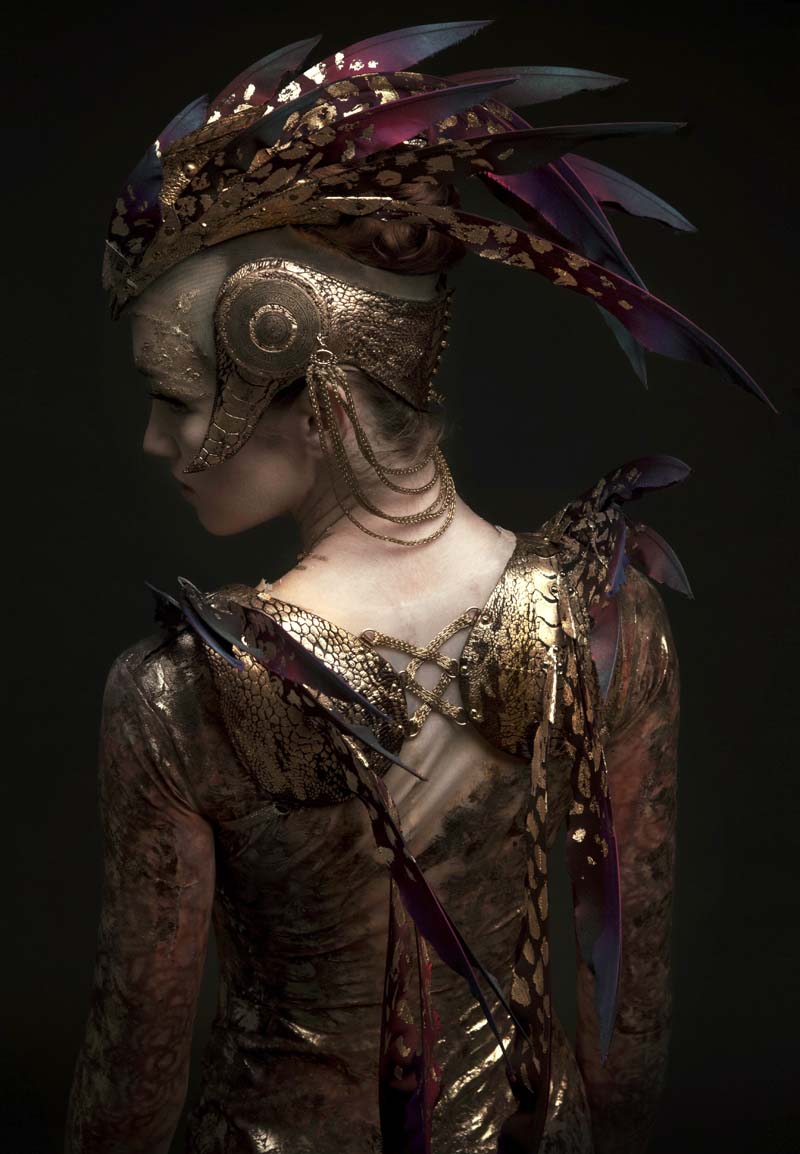 The Firebird: Year: 2012; Head Designer: David Bamber; The English National Ballet.
The piece that Goodwin made for Tom Holland for ‘The Odyssey’ was a sleeveless leather piece they called a jerkin, which was made to look like silver armour. “It’s got very ornate and classical flourishes embossed into the leather surface,” he says.
“It was quite a lot of intricate leather work. I didn’t laser cut anything, it was all done by hand, so it’s a real craftsperson’s piece rather than a manufactured piece. In that sense I’m a leather specialist.
“I’ve also been called a leather cutter, or a couture cutter,” Rob continues. “I used to just call myself a leatherworker, but I do feel I’ve kind of outgrown that title. I’ve got to the point where I’m more involved in the concept and creation. I work with the designer and often the actor to bring a bit more to the piece. Most of the time I’m in the fittings with the actors as you need to see the movement. It’s not just the fit. Sometimes costumes can look a bit ‘costumey’.
“You have to see how the character will wear it and how it will become part of that character, so I like to see how they move in it. It’s like a really good bespoke tailor would ask their client how they’d like their suit to fit and what details they want to include, otherwise you could just buy it off the rack.
“Also, having done a bit of work for the theatre and ballet, you know if the actor or dancer isn’t happy and if it’s not going to work. It’s got to feel part of them and what they’re doing. For me it’s something in between sculpting and designing clothing. It’s like wearable clay in a way. It’s got so much malleability because you can mould it and dye it – especially the veg tan leather, which is the main one I use. It’s an untreated leather, so it’s quite raw.”
The right tools of the trade are an important factor for leatherwork for TV, film and theatre, and Goodwin says he’s built them up over time. Having started out as a shoemaker, he already had a lot of quite specific tools, but he does also admit to creating his own by converting a drill bit or a tool from B&Q, always thinking outside the box.
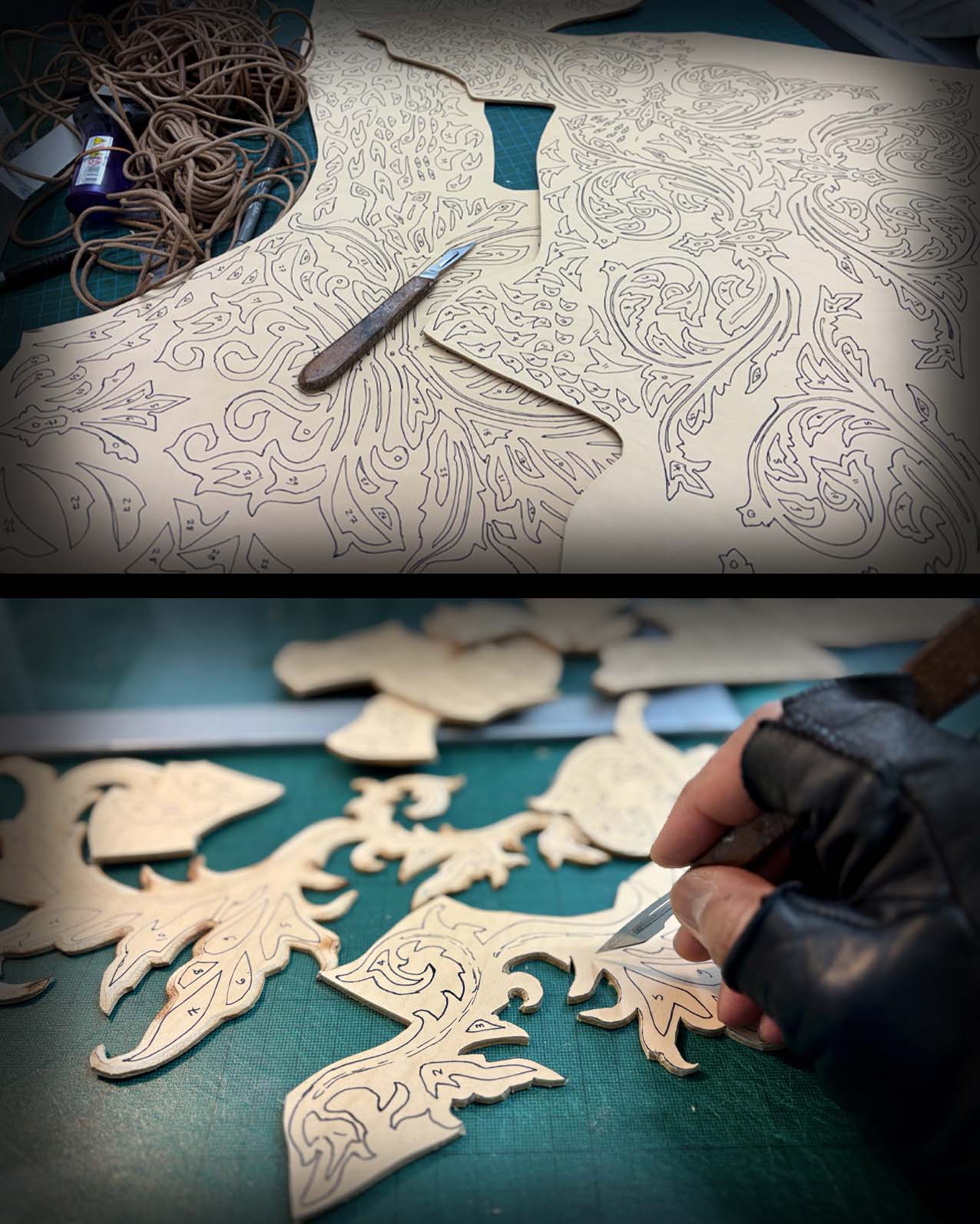
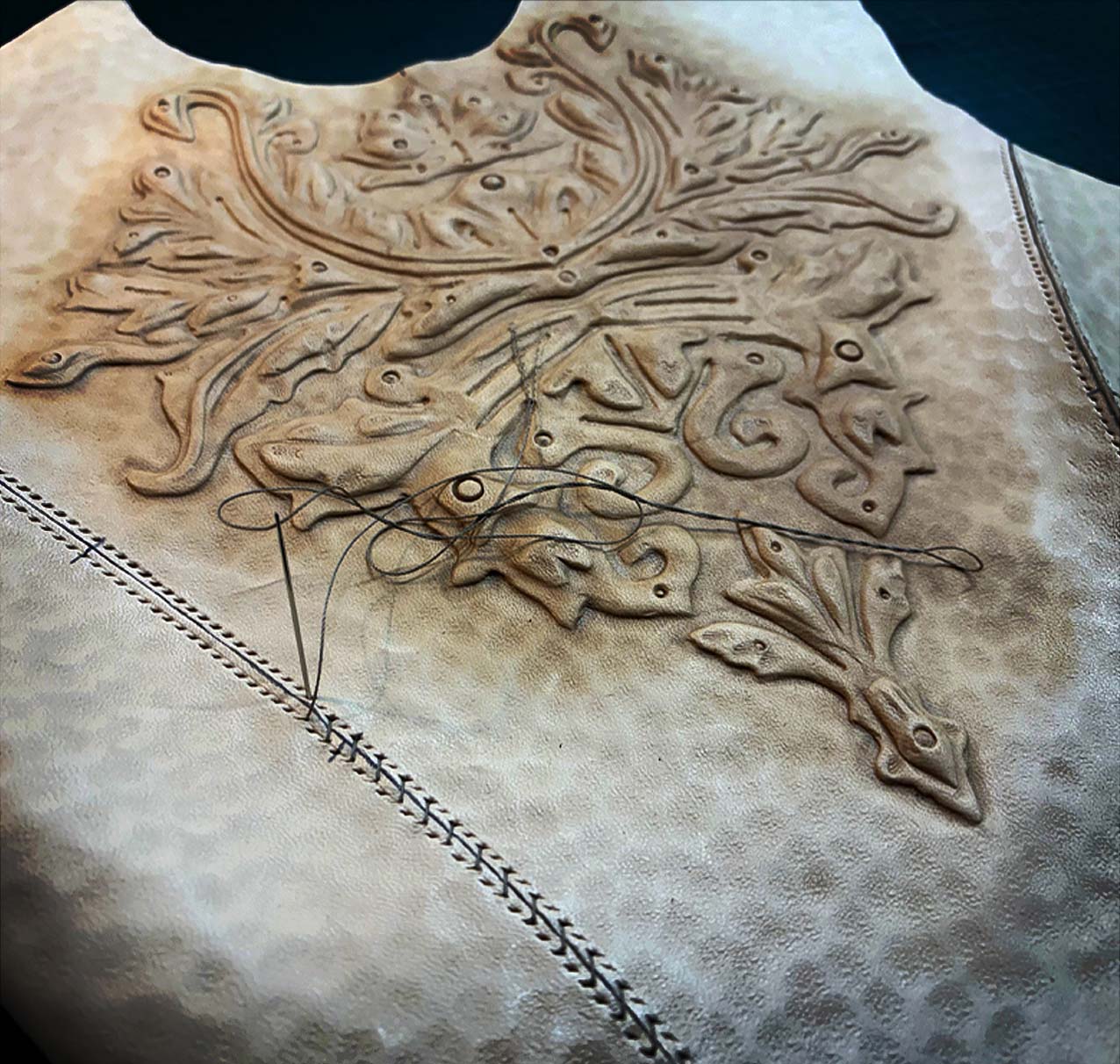
“Sometimes you get a mallet and glue on some pebbles as it gives you a texture on the leather when you hit it,” he offers. “It’s quite unique and it gives you something that looks like it’s been worn in. There’s lots of tricks and you learn more with every project. I’m doing stuff at the moment where I’m making it look like aged bronze Verdigris. It’s flexible but it looks like a statue.”
Goodwin says that, coming from footwear, his primary goal is always to make something that somebody would spend a lot of money on, like a pair of bespoke shoes.“I’m also always thinking about what the customer wants to see up close. I think that’s put me in good stead when it comes to films. Sometimes a lot of the costume teams say not to worry too much as nobody will really see the piece if it’s only going to be in the background. But I always make sure that if you looked at it up close it’s still made to that kind of bespoke quality. You never know, the director might suddenly move that person forward, and then you really will see it (on film). You don’t want to be able to see that it’s all glued together or hanging off with masking tape!
“I even line pieces sometimes. You’re never going to see the lining, but when the actor puts it on it feels like a proper garment that really fits. I like to bring that shoemaking attention to detail to everything if I can. If you’ve got the luxury, the time and the budget that is.”
“There’s something so special about costumes made by human hands, using techniques that have been used across many generations of makers.”
Hopefully, for Ava Harker and George Wright the King’s Foundation’s Costume Craft Programme will lead them on a similar kind of path to that of Goodwin, someone they both know of and very much admire.
Harker says: “I’ve wanted to work in costume for years but had never considered specialising in leatherwork until doing the course. I’m now very keen to follow a career in leatherwork for film and TV and I want to learn as much as possible about this craft. I’m excited to keep developing my skills for years to come.
“We each undertook work placements on two Amazon MGM productions during the course and spending time in every part of the costume department, including the workroom, dye and breakdown, and leatherworking workshop, was an amazing experience.
“There’s something so special about costumes made by human hands, using techniques that have been used across many generations of makers.”
For Carys Hobbs, having got the first year of leading the course under her belt, and having picked up some extra knowledge and skills herself, she is ready to take on the next cohort of students, with the programme once again supported by Amazon MGM Studios – a company eager to find the next stars of the crafts behind the camera.
“We take time in selecting the right people for the programme,” says Hobbs. “It’s such a fantastic opportunity for those who have a real passion for craftsmanship and a desire to learn, and we are so passionate at The King’s Foundation about establishing a new generation of master craftspeople.
“The new students will hopefully find their niche like Ava and George did. They really fell in love with working with leather and are now keen to take that forward into the world of film, TV and theatre. We will continue to support them however which way we can.”