A New Leaf
Funding the Training and Development of Contemporary Bookbinders


From traditional gold tooling to contemporary printing, bookbinding is constantly being reinvigorated by a new generation of creatives. But support for their training is critical to the survival of this centuries-old craft.
Words by Victoria Woodcock
Photography by Paul Read
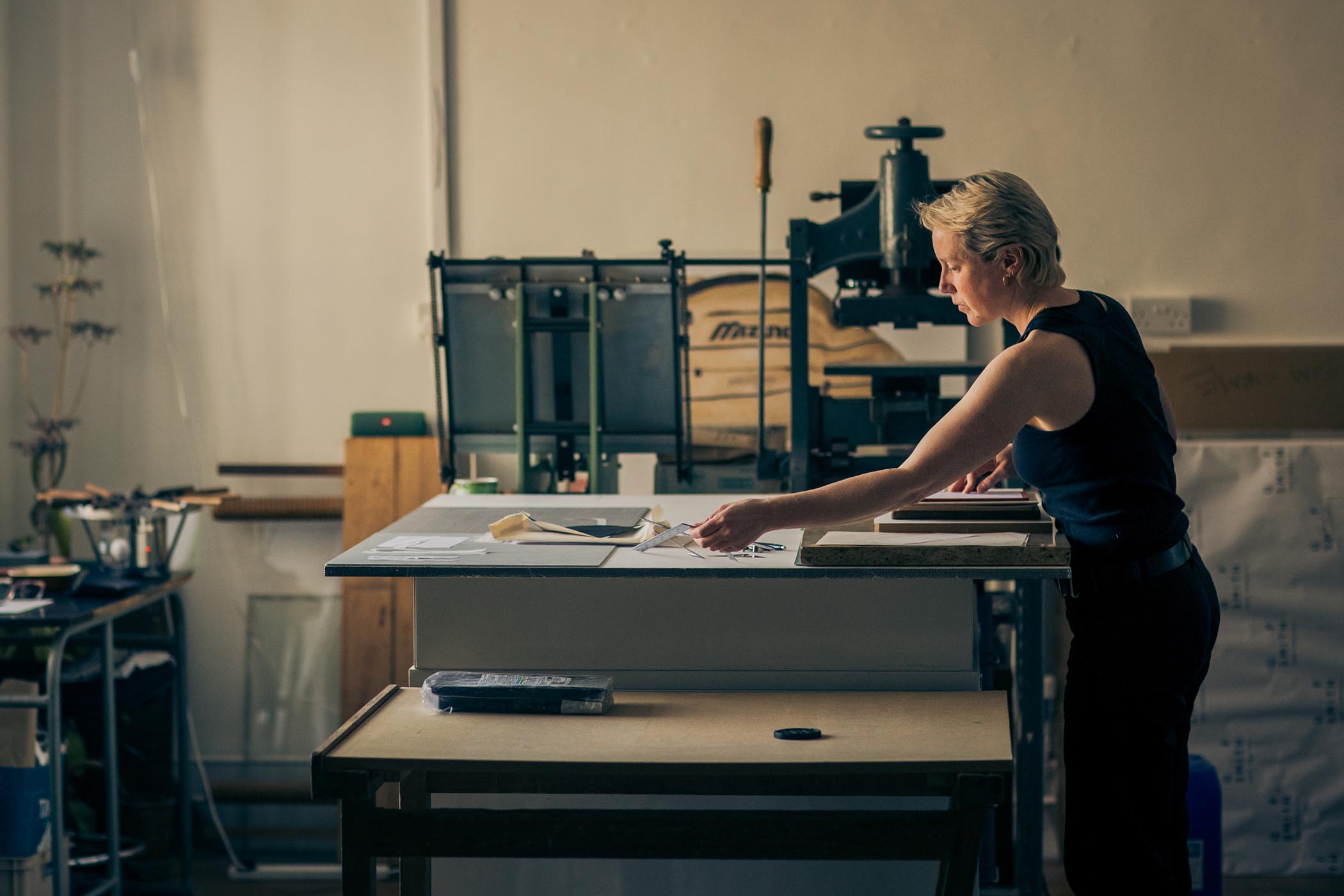
From their Deptford studio, a space run by social enterprise Cockpit, Sim Orme is looking back at how they became a bookbinder. It’s a career trajectory that began at Camberwell College of Art, and “Well, I think…” Orme starts, then pauses. “OK, so, the trashy story is that basically I had a bit too much fun on my [arts] foundation year and I didn’t quite get into the courses I wanted to. There was a rumour going around that the Book Arts course [at London College of Communication] was super easy to get on – and that was where I ended up.”
For Orme, though, a craft struck upon by happenstance has become an enduring passion – one that has encompassed roles at London binderies, creating books for major artists and galleries; led to time spent at the Royal Bindery at Windsor Castle; and enabled learning of traditional techniques such as edge gilding and gold tooling. Orme’s current projects include a “one-off compendium of the Buried Zine, a publication that explores heavy metal music” and a “book with photographer and musician Marie Roux, whose current work is a personal survey of different gardening practices.”
The craft of book construction – binding sheets of paper with needles and thread, then enclosing them in a cover – is believed to date back to the 1st century AD. Early surviving examples include the 7th century St Cuthbert Gospel at the British Library, clad in tooled red goatskin, and the texts of the Egyptian Nag Hammadi Library, generally dated to the 4th–5th centuries and housed in Cairo’s Coptic Museum. But it was after German craftsman Johannes Gutenberg built the first known mechanised printing press around 1440 that bookbinding boomed and leather covers became a creative canvas for decorative processes such as tooling and stamping.
Today, of course, the vast majority of books that pass through our hands are mass-manufactured, glued rather than stitched together, and covered in cardboard rather than bound in leather. “There’s no need now for industrial bookbinders, so it’s more of a craft activity — even shifting towards being an art form,” says Tom McEwan, who set up his own bindery in Irvine, on the west coast of Scotland, in 2013. “There’s always new materials coming along and new structures being devised, so bookbinding has become quite fluid, almost dynamic.”
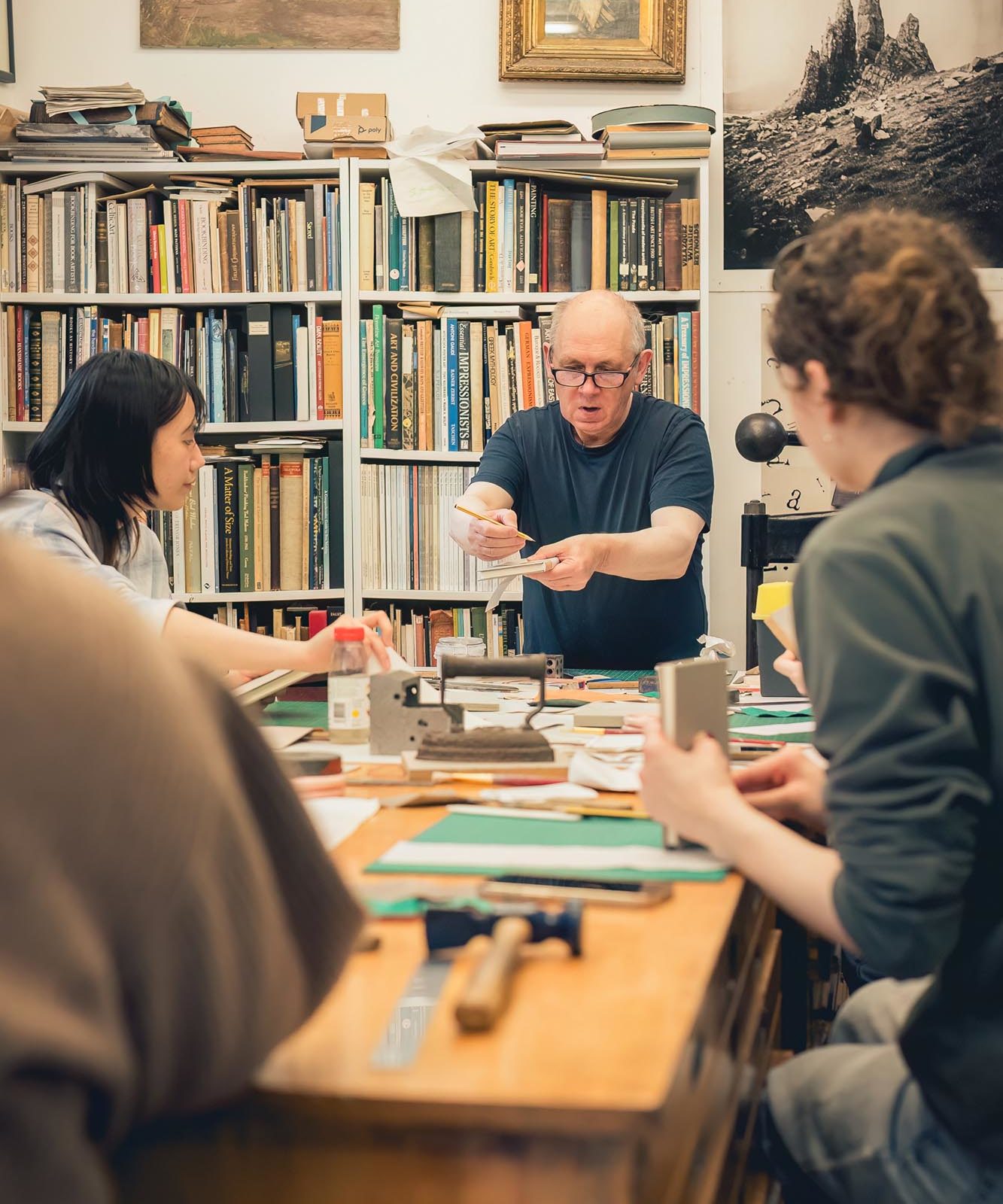 Students of Tom McEwan practising bookbinding in his workshop in West Kilbride
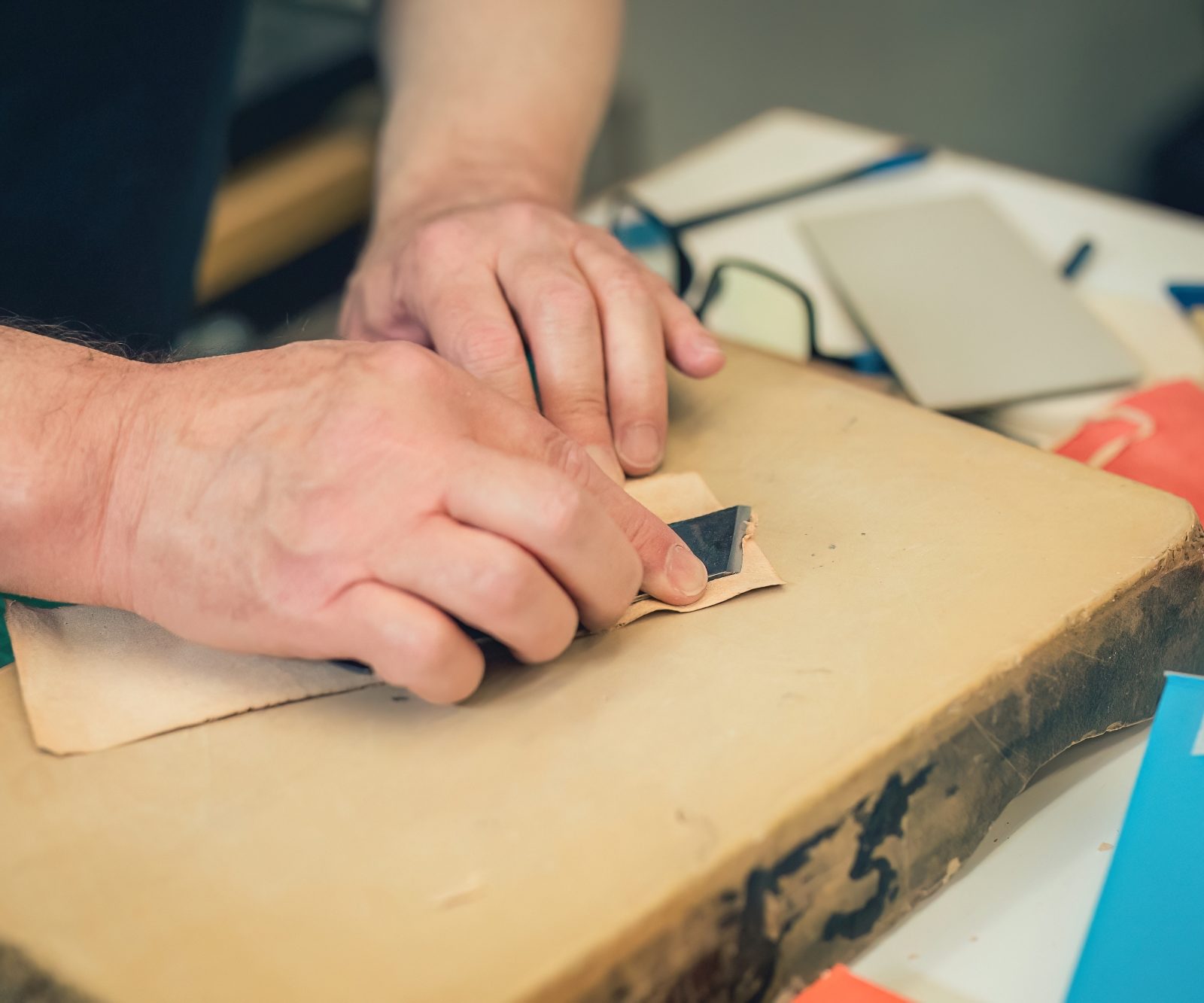
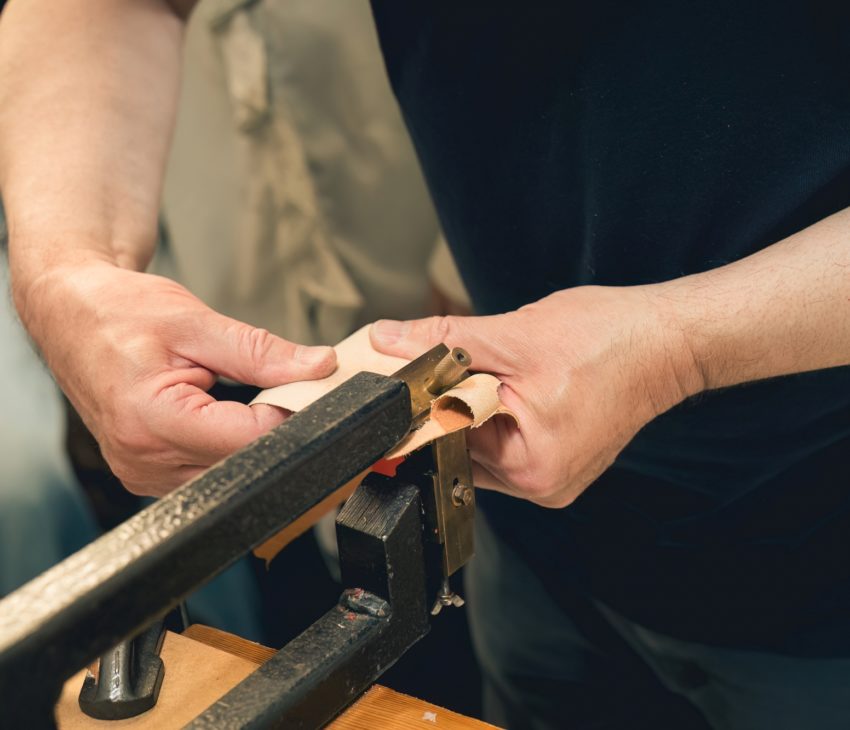
Heritage Crafts, a UK-based charity set up to support and safeguard traditional craft skills, deems bookbinding to be “currently viable.” This means that it has sufficient numbers of practitioners to transmit its traditional skills to the next generation, unlike those considered “endangered” or “critically endangered” such as the related craft of fore-edge painting — creating an image on the book’s exposed page edges. In the UK, the craft is also supported by two active guilds: the Society of Bookbinders and the Society of Designer Bookbinders.
“There’s certainly still plenty of people working in bookbinding either professionally or at a hobby level across the UK,” says McEwan, who has experienced first-hand the contraction of a craft industry. After studying sculpture at Glasgow School of Art he became a die-sinker, a job that involved hand engraving on to metal to make intricate moulds. “I did that for 20 years but new computer-controlled technology came in and gradually took more and more work away from me,” he recalls. He retrained in bookbinding.
“There’s no need now for industrial bookbinders, so it’s more of a craft activity — even shifting towards being an art form…”
McEwan refers to his preferred way of working as “design bookbinding”: taking apart an existing book — “it could be newly published or from a few hundred years ago” — and then “responding to it in an artistic way,” he explains. The book is re-sewn, the spine can be shaped and the page edges can be trimmed and decorated, often with gold leaf finish, but “there’s also ways of printing onto the edge of a book”. The cover, meanwhile, is generally leather, often goat skin or calf skin, which McEwan buys in its natural form “so I can dye it to the exact colour and tone I want it to be.”
One high-profile commission McEwan has worked on is the Booker Prize; every year Fellows of the Society of Designer Bookbinders create a unique binding for each of the six shortlisted works of fiction. In 2023 McEwan’s binding of Paul Lynch’s Prophet Song (that year’s winner) featured an abstract, geometric design in turquoise and deep blues, in hand-dyed goatskin, embellished with foil and carbon tooling, with transfer-printed edges. “There were some very tense, explosive — literally — incidents in [the story], so the design I came up with reflected that element,” he says.
In terms of decoration, “There’s so many different techniques you can use,” says Orme. “You can do onlays, inlays, you can sculpt the leather, then you’ve got all the gold tooling — a really old method to create an embossed cover.” The result is a so-called “fine binding”, made to the highest levels of hand craft. A single book can take four to six weeks from start to finish, suggests McEwan. Orme concurs: “It’s such a lengthy process — it takes forever.”
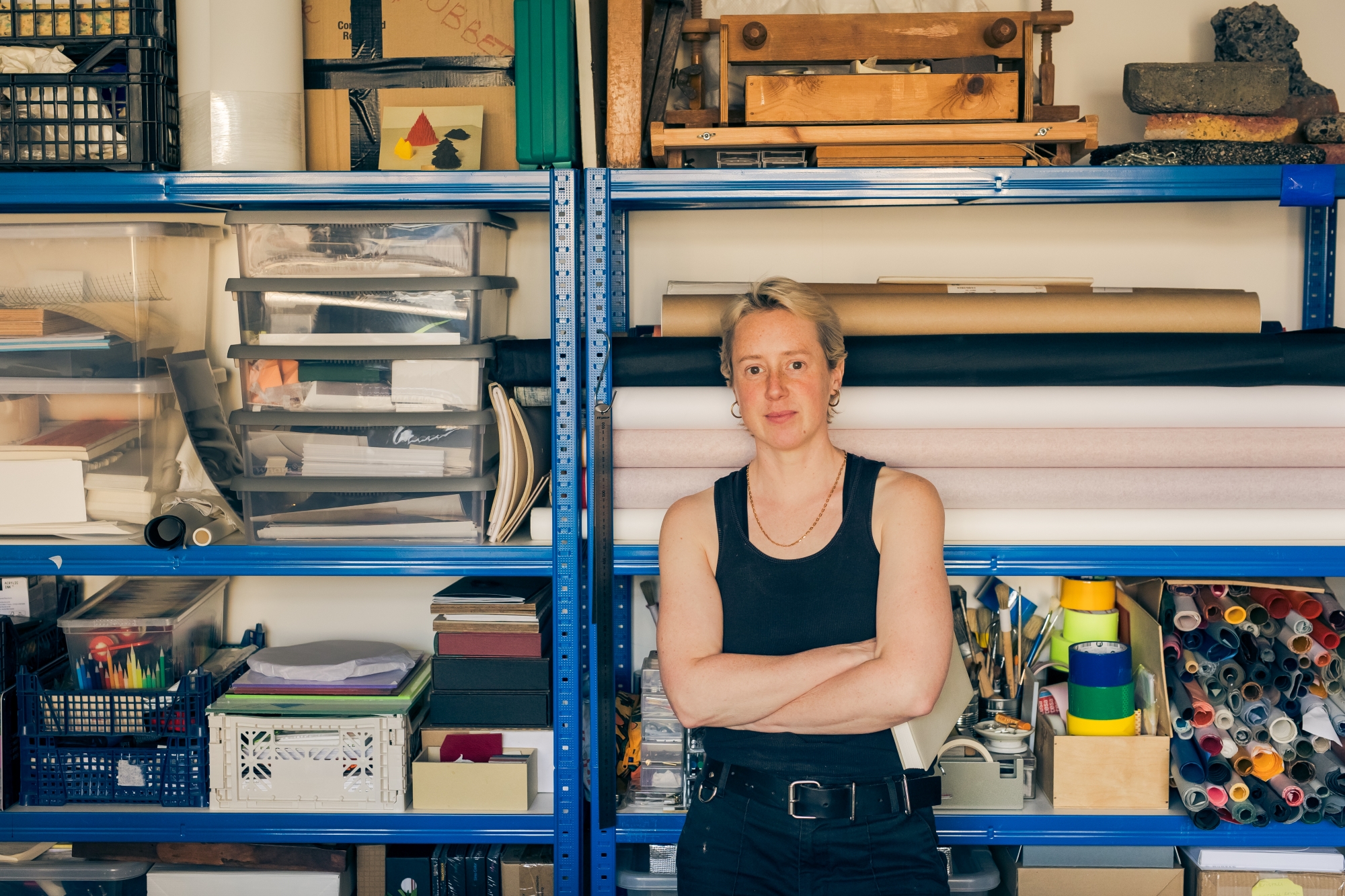 Sim Orme in their studio
Similarly, Orme’s route to becoming a bookbinder was a “very long process over about ten years,” and while the available Book Arts degree course was creatively wide ranging — their final project included a “leaflet/pamphlet”, an “origami tessellation” and a “kind of meta” wire-bound book — it wasn’t grounded in the training required to enter bookbinding as trade. Orme learnt this via roles at a number of binderies, from London’s Wyvern Bindery and Bookworks to George Bayntun in Bath, together with the Queen’s Bindery Apprenticeship Scheme at Windsor Castle (a scheme that has since ended).
More recently, a grant from the Queen Elizabeth Scholarship Trust (QEST) was a turning point. “I’ve been able to learn from bookbinders around Europe and the UK to really hone my skills towards fine-binding – including gold tooling in Paris, gilded edges in Wales, and geometric box-making in Ascona.” When we speak, Orme is about to head to Rimini, Italy to work alongside bookbinder Luigi Castiglione for a week, practising full leather binding. In London, the place at Cockpit is supported by a Leathersellers’ Award and has enabled the establishment of Orme’s own atelier, SO Studio.
“These grants have all been instrumental to my education and growth in bookbinding, which otherwise is almost unattainable in the UK,” says Orme. “There’s so many bookbinding jobs being advertised out there, but there’s a lack of bookbinders in England at the moment.”
“I really want people to see this not as a hobby, it’s not a chichi little crafty thing, it’s a true profession to which you can add your personality, your ability to create, your imagination.”
Heritage Crafts highlights the lack of training facilities across the UK as “a very real concern” for bookbinding. “Where there were once college courses with well-trained teachers from professional backgrounds, these have now mostly closed down,” it states. “Apprenticeships, traineeships and internships are few and far between.”
In the 1990s Victoria Stevens got her start in bookbinding with an “old-fashioned apprenticeship” with a trade bookbinder in Dorset, followed by a qualification in Book Arts (Bookbinding) from the London College of Printing, a course that closed in the early 2000s. She used them to move sideways into book conservation — preserving books rather than making or remaking them — first at the University of Oxford’s Bodleian Library, then in Oxford College collections. She has worked on books, archives and manuscripts such as Dorothy Wordsworth’s Grasmere Journal, T.E. Lawrence’s undergraduate thesis and Jane Austen first editions. “The people who have created, used, and possibly abused an object is as interesting to me as the actual form,” she says. “Keeping that human element in a book is really the thing I’ve come to appreciate.”
For the past year, Stevens has been the subject leader tutor for books and library materials at West Dean, a college specialising in arts, craft, design and conservation, with sites in West Sussex and London. As well as offering heritage conservation studies up to MA level, in 2023 it added a two year Foundation Degree focused on teaching traditional hand bookbinding skills. The students graduating this year can go on to specialise in conservation, through a Graduate Diploma, or continue with bookbinding through an additional top-up year to gain a BA qualification. “That’s where you really start exploring your creative, design side of your book binding,” says Stevens. “It’s very unusual; I don’t think there’s another full time bookbinding course in the country.”
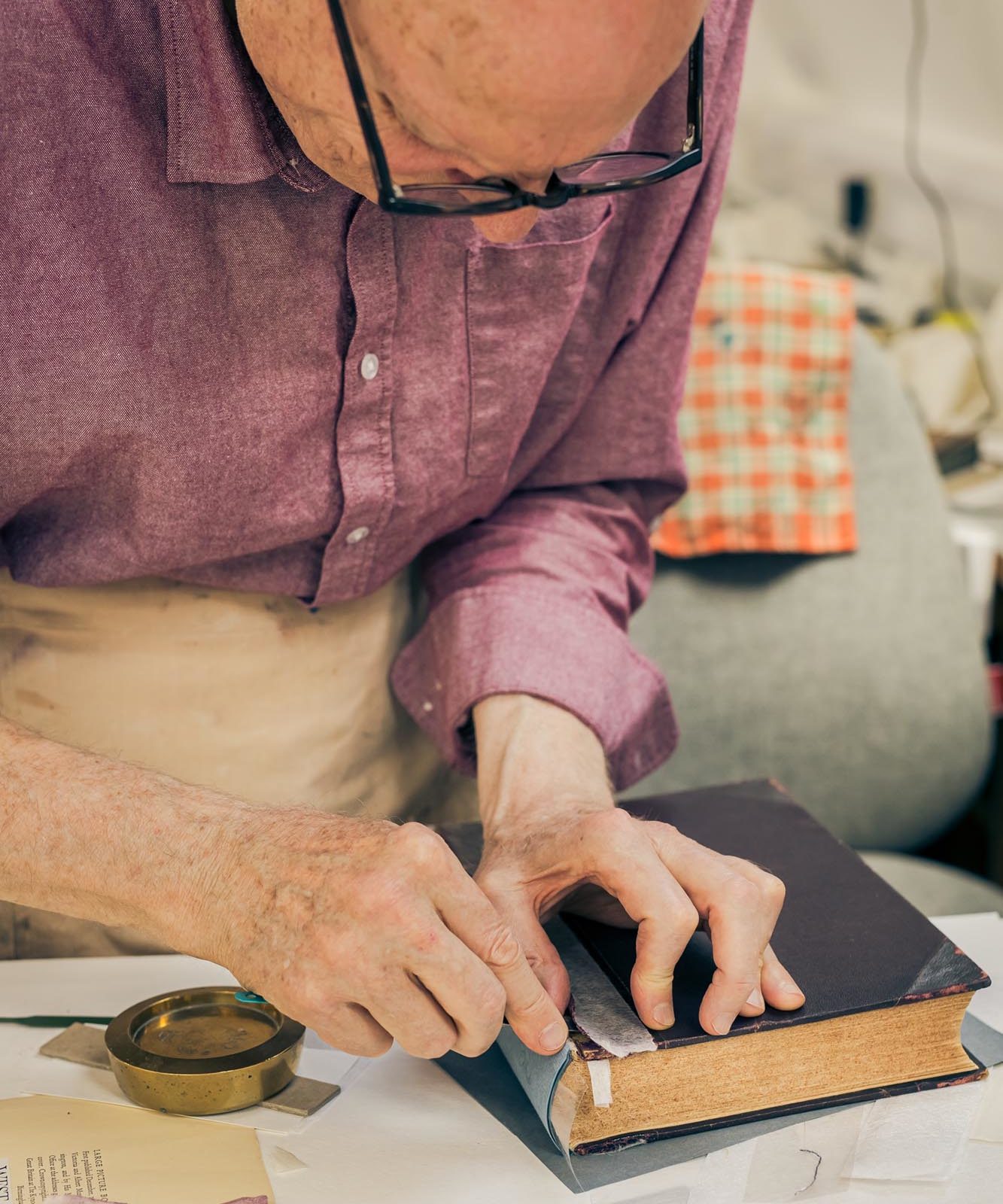 Students at West Dean
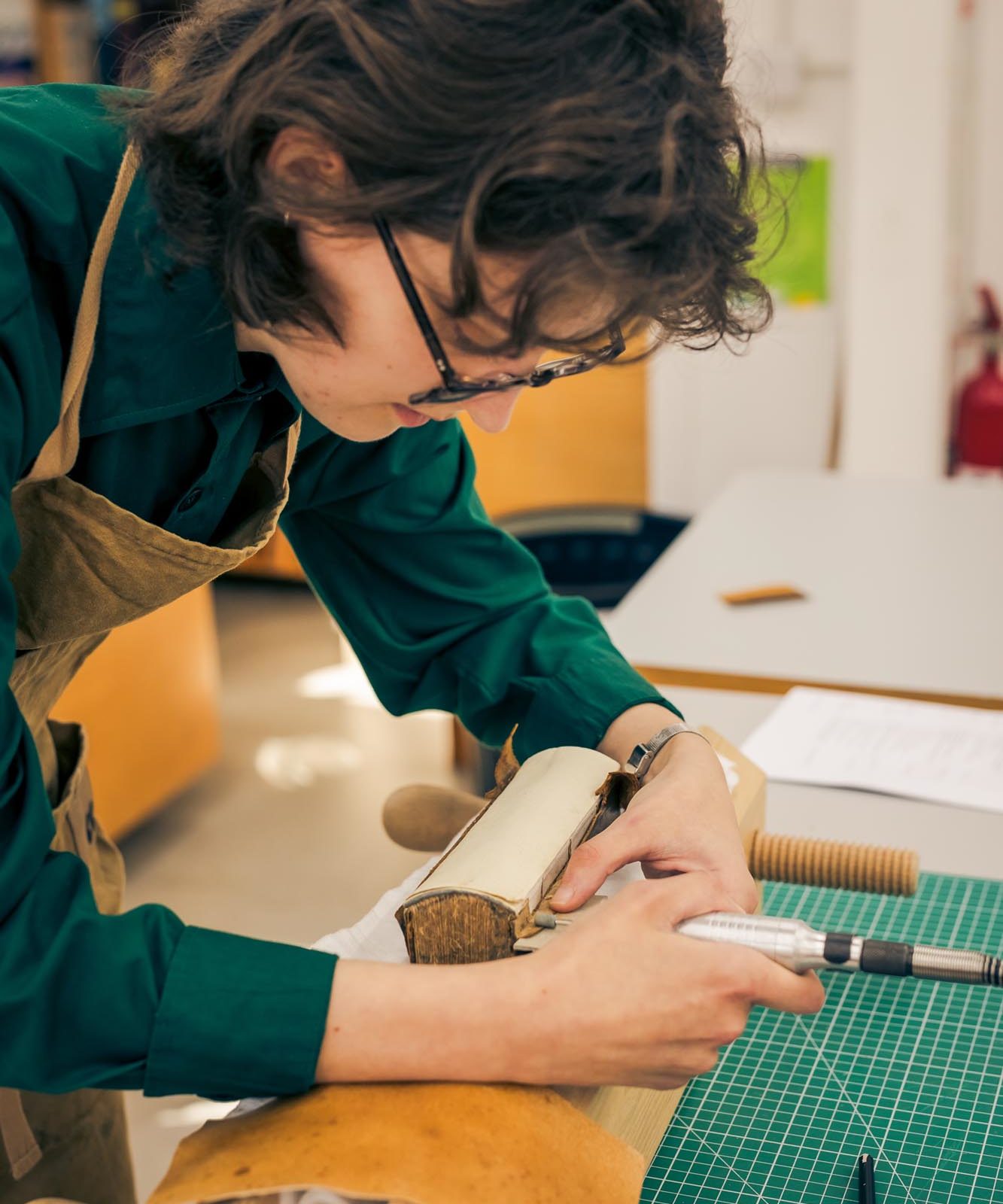
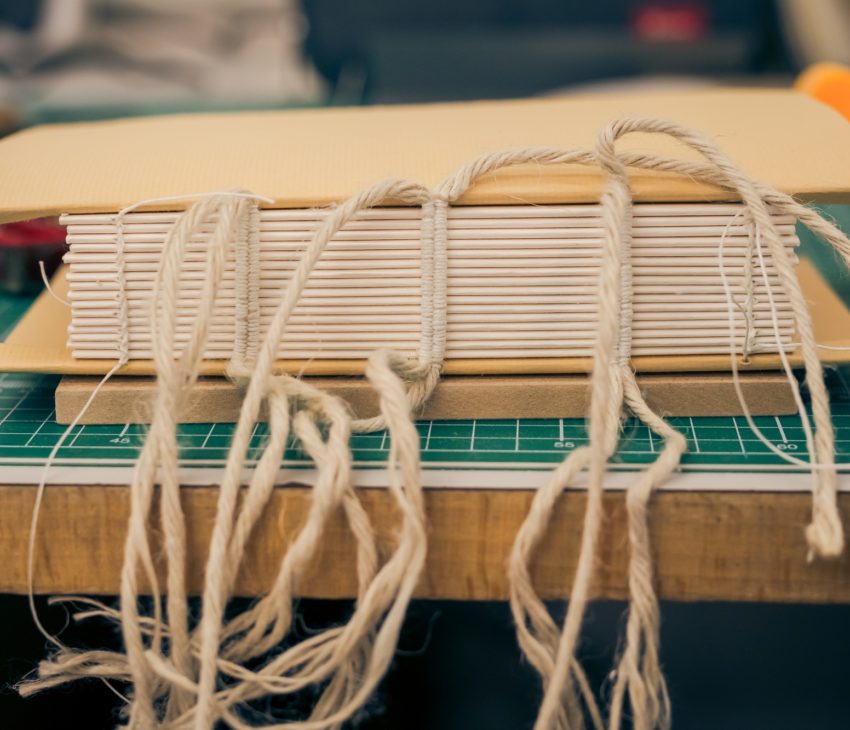
At West Dean, where the courses are being bolstered by donations of surplus leather through the Leathersellers’ funded project, a key aim is to make those leaving school, between the ages of 16 and 18, consider bookbinding as not only a viable career path but a vibrant one. “I really want people to see this not as a hobby, it’s not a chichi little crafty thing, it’s a true profession to which you can add your personality, your ability to create, your imagination,” she says. “Students really get some haptic well-being from it; it is quite a contemplative, focused, calming space to express yourself.”
In Scotland, McEwan also teaches his skills to others, both at his studio and through a scheme with the Society of Designer Bookbinders at universities and colleges such as Glasgow School of Art and Edinburgh College of Art.
The Leathersellers’ Foundation helps to fund the latter with a multi-year grant. As part of its commitment to providing opportunities to gain leatherworking skills, the Foundation has partnered with Designer Bookbinders to bring classes and workshops to students and staff at universities across the UK. It further supports leatherworking skills through various initiatives for artisan leatherworkers. These include awards providing subsidised space and business mentoring at Cockpit (which houses the Leather Hub, a communal space with specialist leather tools and machinery), apprenticeship support, training bursaries through Heritage Crafts, and QEST scholarships.
“More and more [students] are making the content of the book as well as the binding; they might write it, or it may not even have words, it could be illustrations. It’s a new direction that bookbinding seems to be taking.”
McEwan has taught two QEST recipients, who receive up to £18,000 to develop their skills in their chosen craft. “It means I can take people close to the highest level, technically, and go into the design side in more detail,” he says. He’s also noticed a shift in how his students approach the subject, towards “book art.” “More and more of them are making the content of the book as well as the binding; they might write it, or it may not even have words, it could be illustrations. It’s a new direction that bookbinding seems to be taking.”
Stevens’ students too are using the traditional bookbinding toolset in increasingly outré ways, she says, while Orme adds that running their own business means striking a balance, both creatively and financially, between more traditional and more experimental work. “Fine binding commissions don’t come along very often. It’s a very specific request, and can cost thousands, so you have to diversify — and I’m particularly happy about this because I love making boxes. So if anyone wants a bespoke box, come to me.”
—
The Leathersellers’ Foundation provided grant funding of £6,500 to Designer Bookbinders for 2024–2025 towards their ‘Transferring Design Project’ that reintroduces bookbinding classes into art and design study. After three successful years of this, three universities have already developed bookbinding modules within their curriculum, and with our ongoing support we hope that this will continue to grow.
READ MORE
Excess Strategy
The Leathersellers’ Surplus Leather Project is opening the door of opportunity for the next generation of leather designers.
A Well-Heeled Foundation
London’s Jimmy Choo Academy is laying the groundwork to put the future of UK leather craft firmly in the luxury crosshairs.

Earth-minded
How UK leather pioneers are setting global standards in sustainability.