Deni-Deni
From pioneer to preservation


Royal handbags, boxing belts, Manhattan interiors: from her workshop in Lancashire, Denise Pearson has quietly shown that in an ever-growing bespoke and luxury sector, there remains strong demand for high quality creative hand-skills. Ensuring these skills continue to remain part of the British landscape of leathercraft is quickly becoming part of her evolving legacy.
Words by Emma Crichton-Miller
Photography by Alun Callender
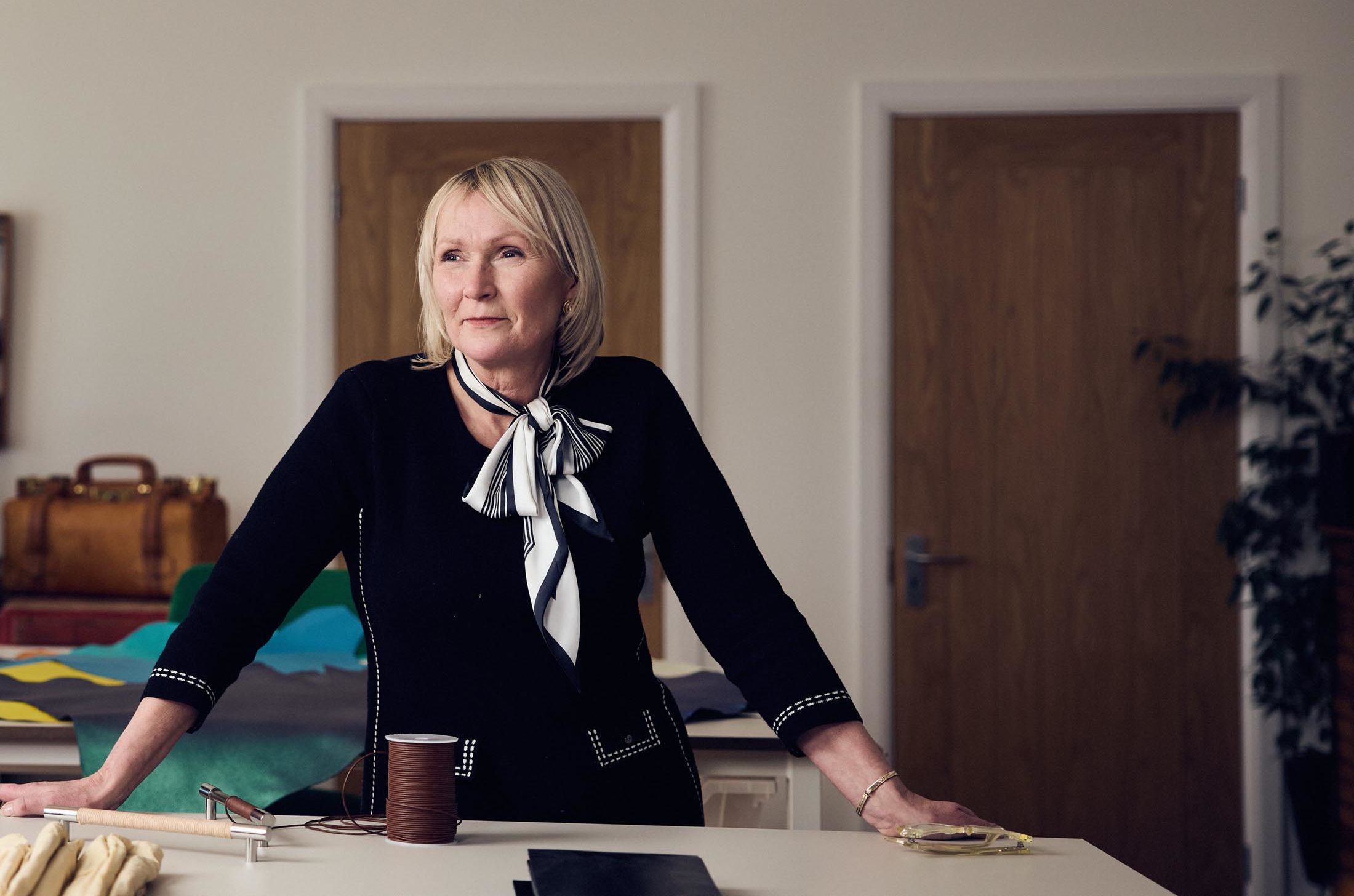
The dramatic landscape of Rossendale in East Lancashire, just north of Manchester, was once a significant centre not just for the cotton industry but also for shoe manufacture. Today, there is little left of either. But for the last twenty years, in a repurposed brick warehouse, on the edge of the town of Haslingden, high above the River Irwell, one woman has created a bespoke leather-business that draws on multiple skills in both leather and textiles. Today, as she makes work of the highest quality, for clients reaching across the globe, she has become an advocate for those same skills, campaigning to reintroduce them into this valley and beyond.
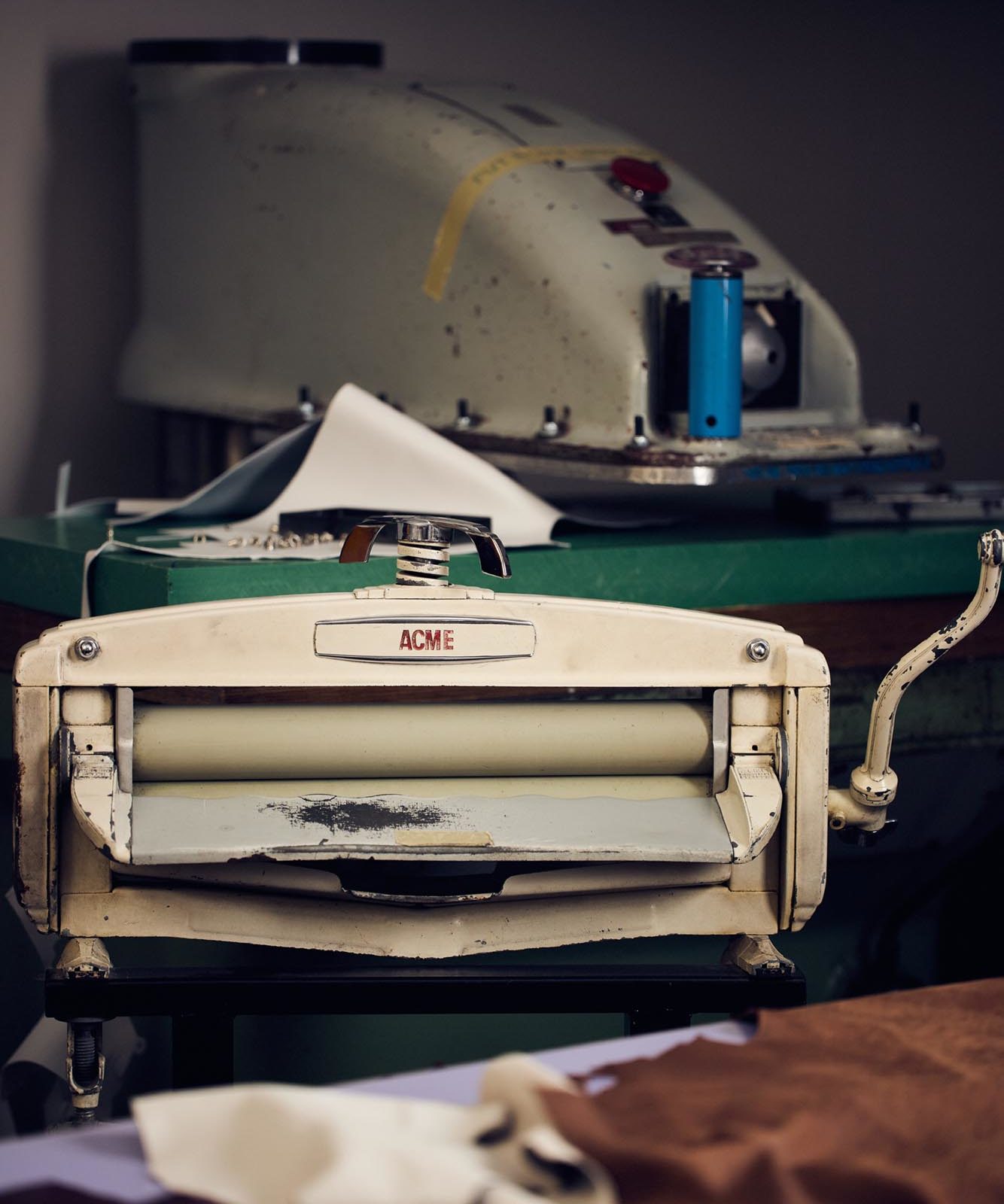
Denise Pearson set up Deni-Deni twenty years ago. From two main work areas – one crowded with specialist machines, many rescued from liquidated businesses, upper shelves neatly packed with specialist threads, hardware, leather and other materials; another clean and bright with sewing machines and work benches – she produces exquisitely finished work created for some of the world’s leading luxury brands. Exclusive fashion brand Erdem; the venerable Mayfair-based fragrance, skin and hair care brand D.R.Harris; Camilla Staerk in New York, a leather specialist fashion and homeware designer inspired by the leather saddles of her youth; the bespoke British kitchen and furniture makers, Smallbone, from Devizes in Wiltshire; prestigious sports’ organisations and even the British Royal Household, are just some of Deni-Deni’s distinguished patrons. Alongside, Denise responds to personal requests for help resolving a technical issue with leather buttons or research and development for the structural possibilities for a future handbag or the creation of a unique leather and burr oak stationery bureau with matching address book for a client’s wife. Any technical cry for help is met with whole-hearted enthusiasm and meticulous research, and a refusal to be daunted by any challenge.
Denise credits both her technical skills and her relentless professionalism to her education and upbringing. Born in Newcastle upon Tyne in 1963, an only child, her enterprising father, from West Jesmond, took the family to New Zealand when she was three. There he worked as a butcher. Three years later, the family returned home, settling after a while back in Newcastle, where her parents built a business as a butcher and baker in nearby Hebburn. Meanwhile, Denise reports, many family members had a creative bent and made things, including her father, with a perfectionist streak that Denise has inherited. Denise’s father took her frequently to museums and art galleries, encouraging her interest in art, while Denise’s paternal grandmother, who had been a tailoress, patiently sat with her whilst sewing in the kitchen. So when in her teens, Denise moved to a school with a very strong Art department and a “phenomenal” needlework teacher, she was in her element. Art and needlework became her favourite subjects, at which she excelled, with the art room a constant refuge, she explains, “How I feel on the bench today is how I felt when I was fifteen.” It is her happy place.
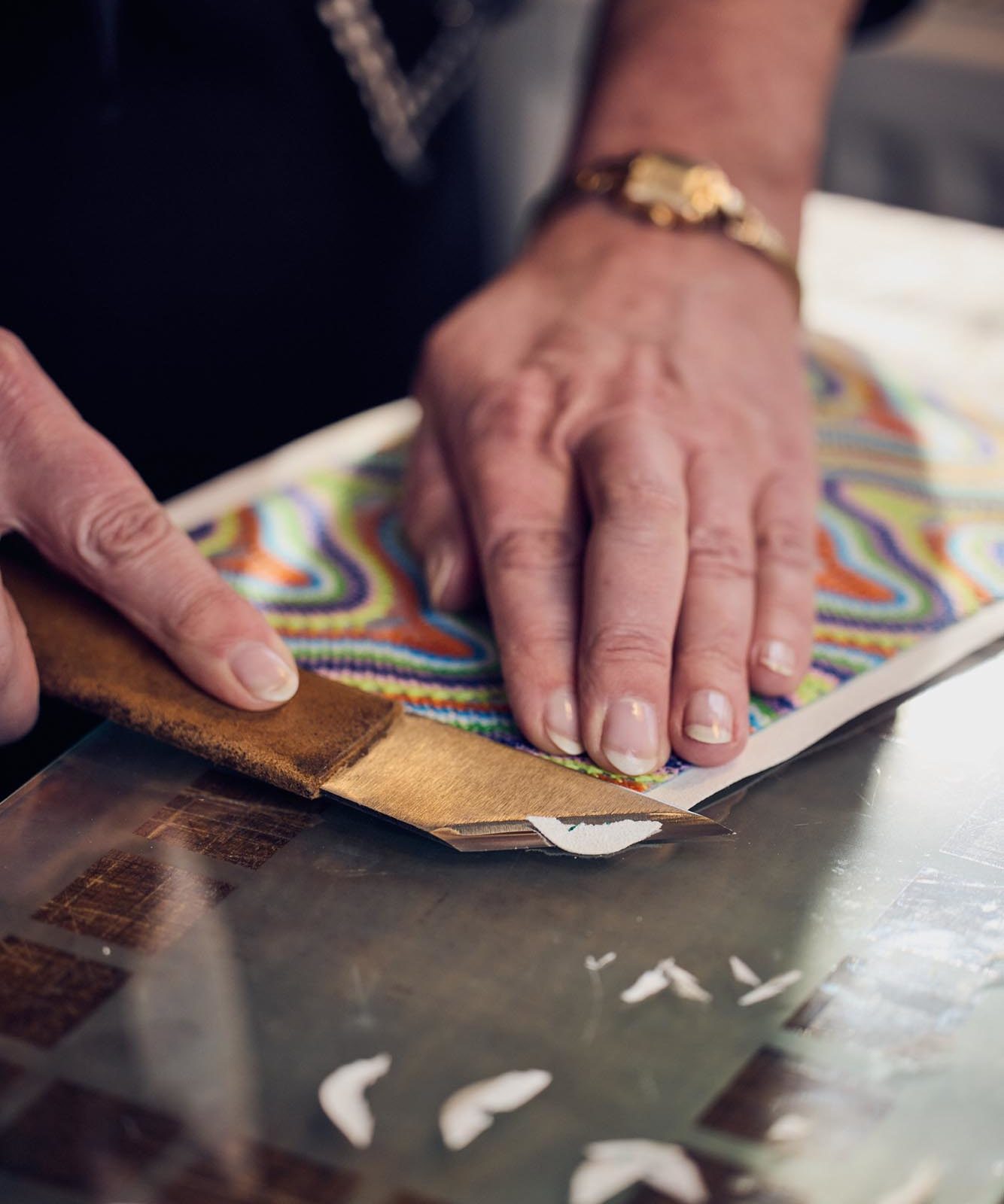
Denise moved on to Sunderland Polytechnic for her Art Foundation. It was there she realised that she wanted to be a designer craftswoman. Travelling around England looking at polytechnics to make her next step, with her boyfriend Eddie, she picked the Cordwainers (now part of the London College of Fashion) in London: “It was either that or a jewellery course in Newcastle. I had no idea the college was so prestigious.” There were three strands at the Cordwainer’s, one of the most respected specialised leather-skills schools in the world: footwear, leather-goods and saddlery. Denise chose leather-goods. Here she learned to make handbags – “soft, structured and framed,” small leather goods, box-work, cigar cases, book binding and luggage. She comments, “When I trained at the Cordwainers Technical College the teachers were proficient in their craft. They came from industry. Lessons were structured like school. If you listened and worked hard then you left college and could carry your tools to your first job and hit the ground running in any factory.”
At the end of the two-year course, Denise won the Worshipful Company of Cordwainers gold medal amongst her entire year. Another prize included a Tanner Kroll large leather Gladstone bag which is displayed in Denise’s workshop – a mark of her early distinction. At the time however, Denise reports that she “put all my awards and gold medal in a drawer and got my first job” – with Lewis Airlock, making tobacco pouches and small leather goods out of baby lamb leather, “particularly difficult to work with”, manufacturing for Burberry and other Bond Street companies. This was benchwork, in a top-floor workspace “rammed with benches and machines.” Denise says, “I had my own bag of tools and I just sat down and got on. I could make as well as many of the people in that room but learned production speed and tricks of the trade.” After about eighteen months, Denise was headhunted by Antler Luggage and moved to Bury. At that point the company still had some sampling and production in this country. “At Antler I was given my own small design office. I hadn’t been told that I couldn’t get involved with the making in the sample room and well, I was lost. Management had taken me on as a designer as they loved my work, but the way I function is tactile and I couldn’t do one without the other.” Denise quickly found a role at Regent Bags in Salford, designing and pattern making synthetic handbags for The British Shoe Corporation and market stall holders. “Having to design bags that the piece rate workers could make quickly took skill and my German design colleague at Regent taught me a lot.”
It was at this point that Denise almost abandoned the trade. Skilled workmanship and beautiful products were her passion but opportunities for specialist leather workers were disappearing. Denise kept her leather machinery and tools at home, while working on and off for Yellow Pages between giving birth to her two children. It was hard – payment by commission – but as Denise says, “That selling experience has benefited me every day since. I am comfortable knocking on doors and picking up the phone.”
A stint in Jersey, however, designing and painting pottery, inspired her to reconsider how you might build a creative business: “The general public could walk around the factory and watch us working before going to the shop. There was a restaurant attached. That business model stayed with me.” This job sowed a seed that has continued to grow in Denise’s imagination: the idea of establishing a hub where the general public and individual craftspeople and creatives can come together, where work can be made and sold, the workshops like an open kitchen.
“The fact that clients track Denise down in Lancashire from all over the country, for a great variety of projects, shows that not only are the skills of the leatherworker in demand but a lot of essential knowledge and experience is sometimes locked up in a few individuals.”
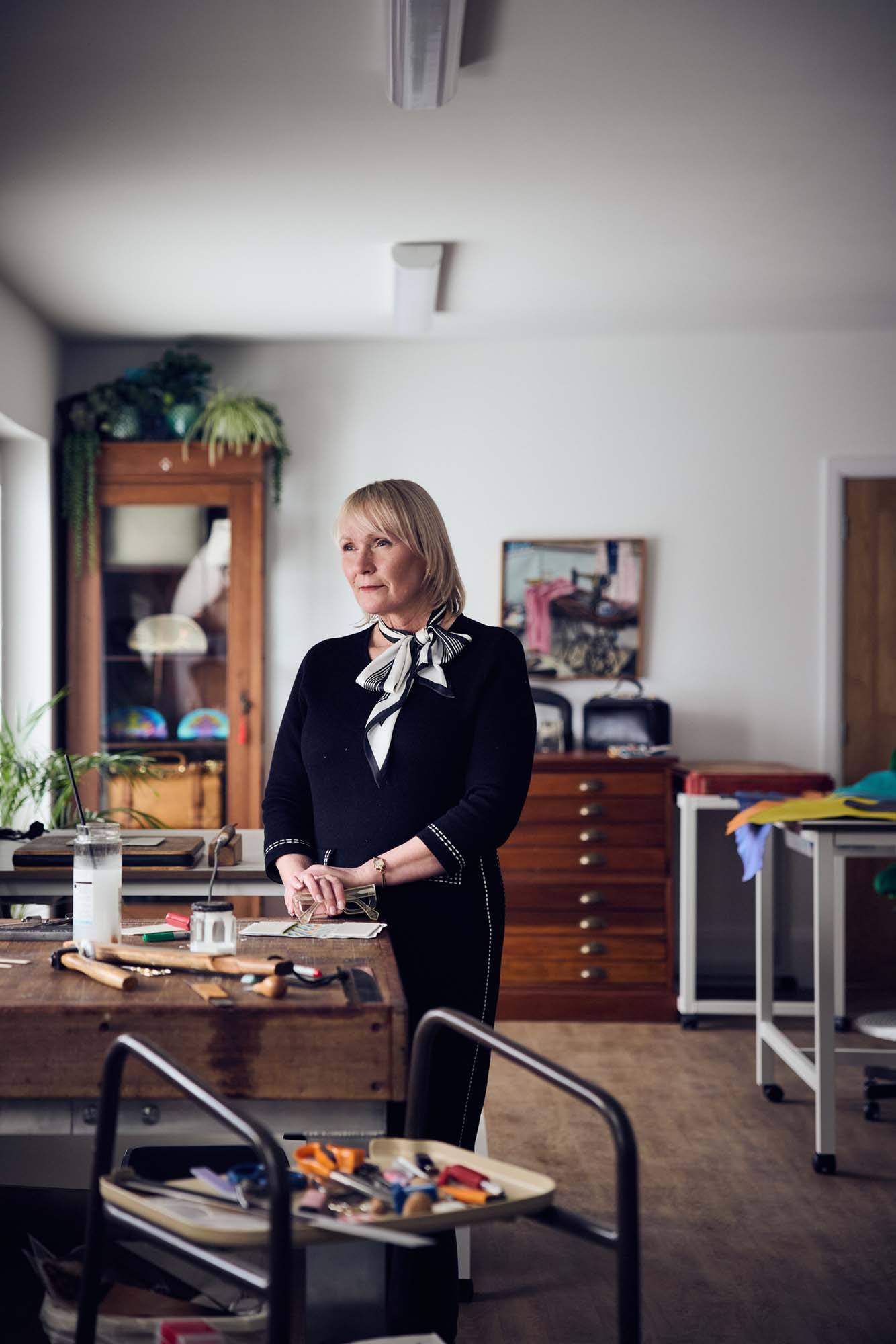
With renewed commitment to her own professional expertise, in the late 90s, Denise took a job at Gilmour Fine Leather Design Ltd in Wigan, a small handbag manufacturer and sample house for Billy Bag, fashion designers, Herald and Heart Hatters, House of Colour, Asda and other high street retailers. Her role involved developing fashion designers’ briefs to production stage and the broader market, whilst developing existing ranges. Denise oversaw quality control, sourced materials, and both initiated and maintained customer relations. These multiple responsibilities stood her in good stead when the company collapsed. Acquiring some of their machines, Denise set up on her own in 2005, moving to her current premises in 2006. The sad, yet fortuitous liquidation of an associates leather goods factory that same year “set me up as a ready-made factory. The large Fortuna [leather] splitting machine was the reason I bought the whole lot. They are like gold dust.” The machine enables Denise to create uniform thin layers of leather to cater for any degree of precision and refinement.
Since 2005 Denise has slowly built her clientele. She explains “The trick is to identify a need and fulfil the need.” She left her card with Lock & Co. Hatters in St. James’s Street, London, and within two weeks was designing and making all their handbags. This collaboration led to her making over fifty handbags for The Royal Household, five of which were in Westminster Abbey at the 2011 Royal wedding of today’s Prince and Princess of Wales, including the handbag carried by the Queen of Norway.
Spotting a clutch bag in the window of Joseph Azagury’s Knightsbridge shoe shop, Denise introduced herself and began to supply handbags for them also. She would look through magazines and challenge herself to find three leads in every issue. But while handbags are a beloved specialism, a technical challenge, they are not the only goods Denise creates.
Iain O’Mahoney worked for many years at Smallbone of Devizes in research and development. When the firm took on a high-end residential project in Manhattan, in the early 2000s, providing kitchens and interiors for over 1000 apartments, on 57th street, Denise came on board to deliver leather handles, leather liners, leather boxes and other luxurious finishes in unusual and exotic materials that would allow the client to feel they had something unique. “Denise worked so hard to understand what we were trying to achieve. If you want to elevate a secret drawer, for instance, she would create wonderful, quilted leather interiors,” O’Mahoney says. Since then Deni-Deni has made all the leatherwork for Smallbone.
Some projects have represented spectacular leaps in the dark. When the 200-year-old Birmingham based silversmithing business Thomas Fattorini Ltd was commissioned to create the first new Ring Magazine Belt for the new sponsors of this prestigious global boxing title, they could not find anyone to make the fabric parts of the leather belt. Thomas Fattorini Ltd are experts in bespoke medals, and have been making the Lord Lonsdale Challenge Belt, a British Boxing Award, for many years. This was a high stakes opportunity because the Ring Belt was to mark the relaunch of the franchise under its new Saudi owner, and was going to be presented in Times Square, in New York. Thomas Fattorini says: “Denise is a passionate craftsperson, with very high standards.” Although her costs were high, owing to extensive research and development, “the way she understands leather and the quality of the stitching made it worthwhile.” She has now been helping Thomas Fattorini Ltd deliver the missing Ring Belts not created when the franchise was in crisis.
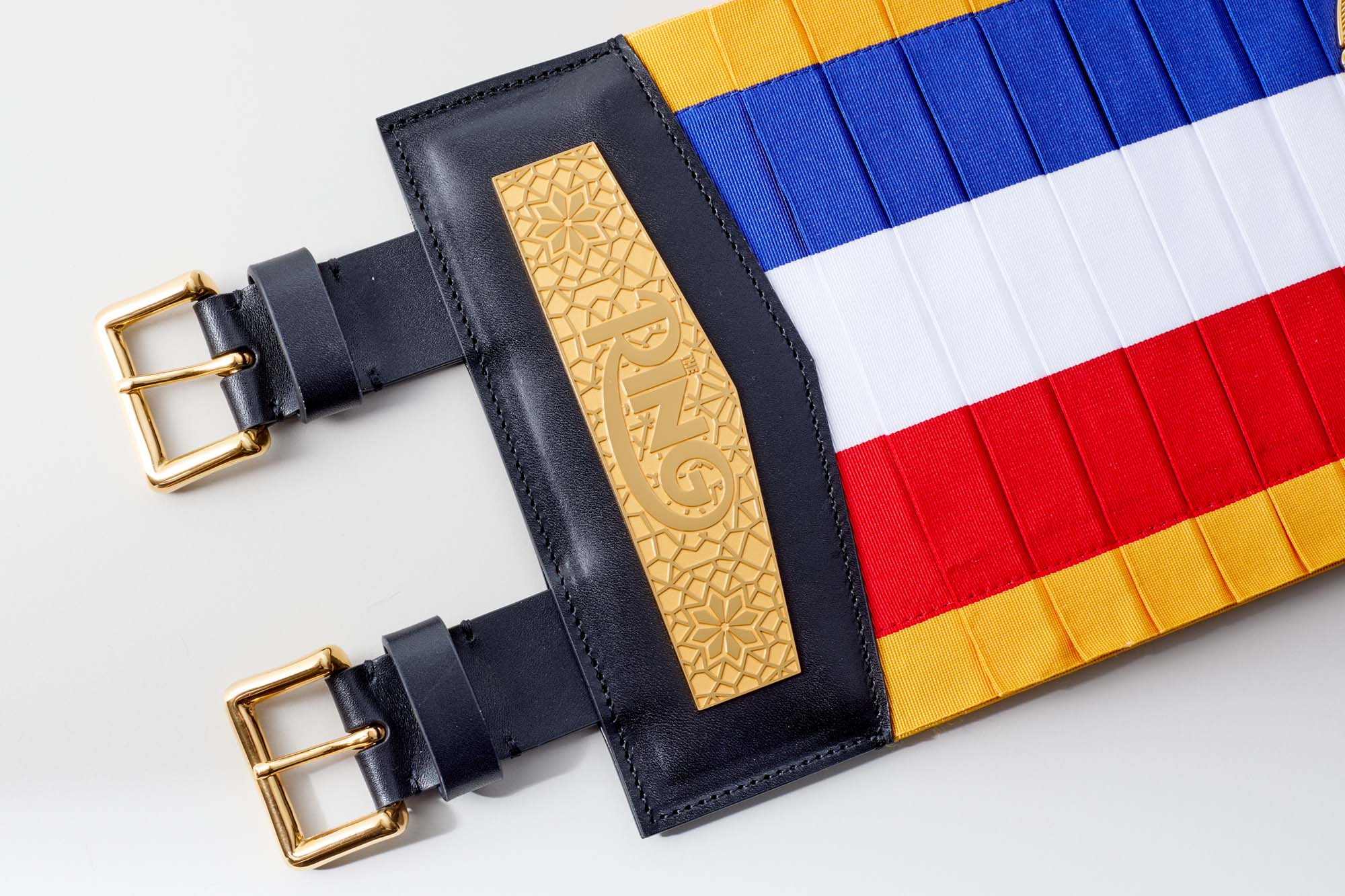 Ring Magazine Belt
“It looks a simple process but that is only because the job has been done perfectly.”
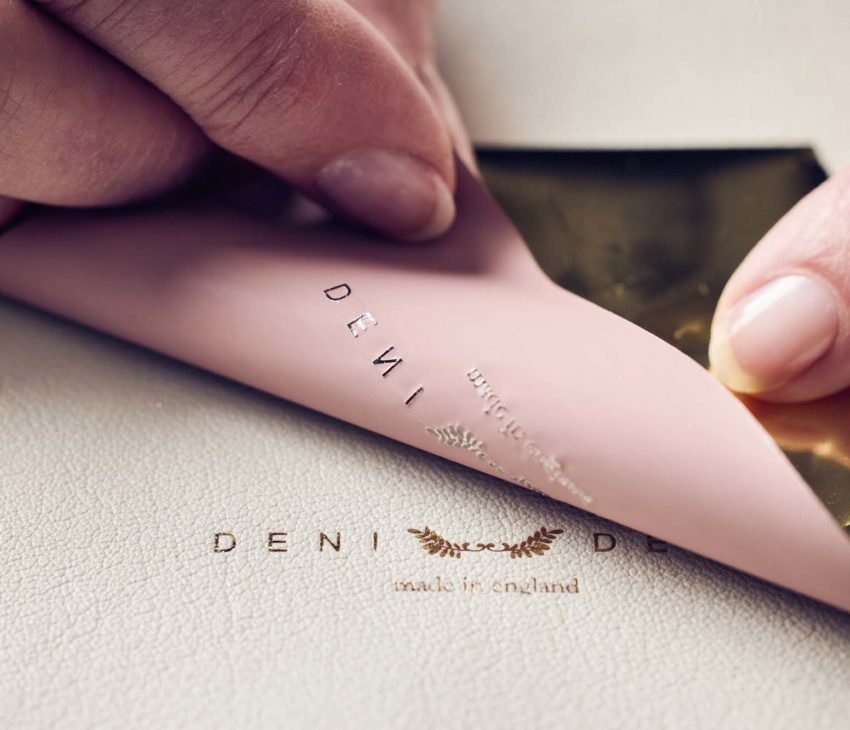
Jonathan Fawcett, of yacht model makers David Fawcett, had a similar technical conundrum when they proposed a new cabinet idea to the design team of the Richard Mille Cup, to house the model yachts gifted to sponsors of the race. The Richard Mille design team specified a pale upholstery leather wrapped around the backboard. Denise, however, suggested an alternative that provided a cleaner, more refined finish and greater visual impact. She says, “They accepted my proposal and, this year, also added my suggestion to deboss the leather.” This large format debossing utilized one of Deni-Deni’s larger pneumatic blocking machines. Fawcett says, “Denise’s standards are as high as I could possibly imagine. It looks a simple process but that is only because the job has been done perfectly.”
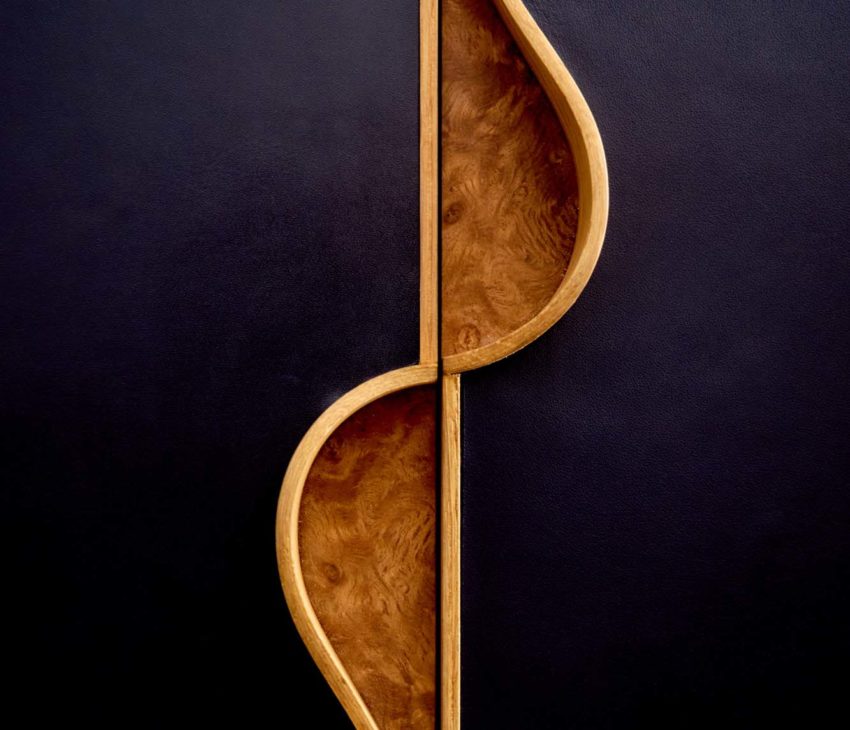
One particularly absorbing project was the unique burr oak and leather stationery bureau that a client, David Jardine, commissioned for his wife. He had initially offered his wife a bespoke handbag, but she was clear that she wanted a beautiful writing case. “The word bespoke does not do it justice,” Jardine explains. “Denise came to our house to get to know us and the context where the piece was going to live. She wanted to know which pens we use in order to customise the pen-holders. The whole thing was an incredibly detailed and very thoughtful process.” Denise tracked down a craftsman to make the boxes and insisted on getting the hinges to lie as flat as possible. She also made a personalised address book with hand-painted flowers by every letter. Jardine says, “We call it the heirloom because it is so lovely. It sits in our hall. And the children are already vying for it!”
The fact that clients track Denise down in Lancashire from all over the country, for a great variety of projects, shows that not only are the skills of the leatherworker in demand but a lot of essential knowledge and experience is sometimes locked up in a few individuals. In some cases there is literally no one else who can do the job. It is this realisation as well as her innate desire to help people that has propelled Denise into her latest project: Deni-Deni Academy. Its first goal is establishing a course of instruction in leather working and footwear skills that can be delivered to 14- to 16-year-olds. “Schools don’t teach what they used to. It’s extremely upsetting” Denise comments. With the support of UKFT, and the Leathersellers and Saddlers, Deni-Deni is registering as a training centre, acquiring tools and equipment and developing a curriculum. Denise says: “There are many talented leatherworkers whose skills will never be passed on because of factory closures but we have to adapt to changing times, look to the future and think how can we offer opportunity.”
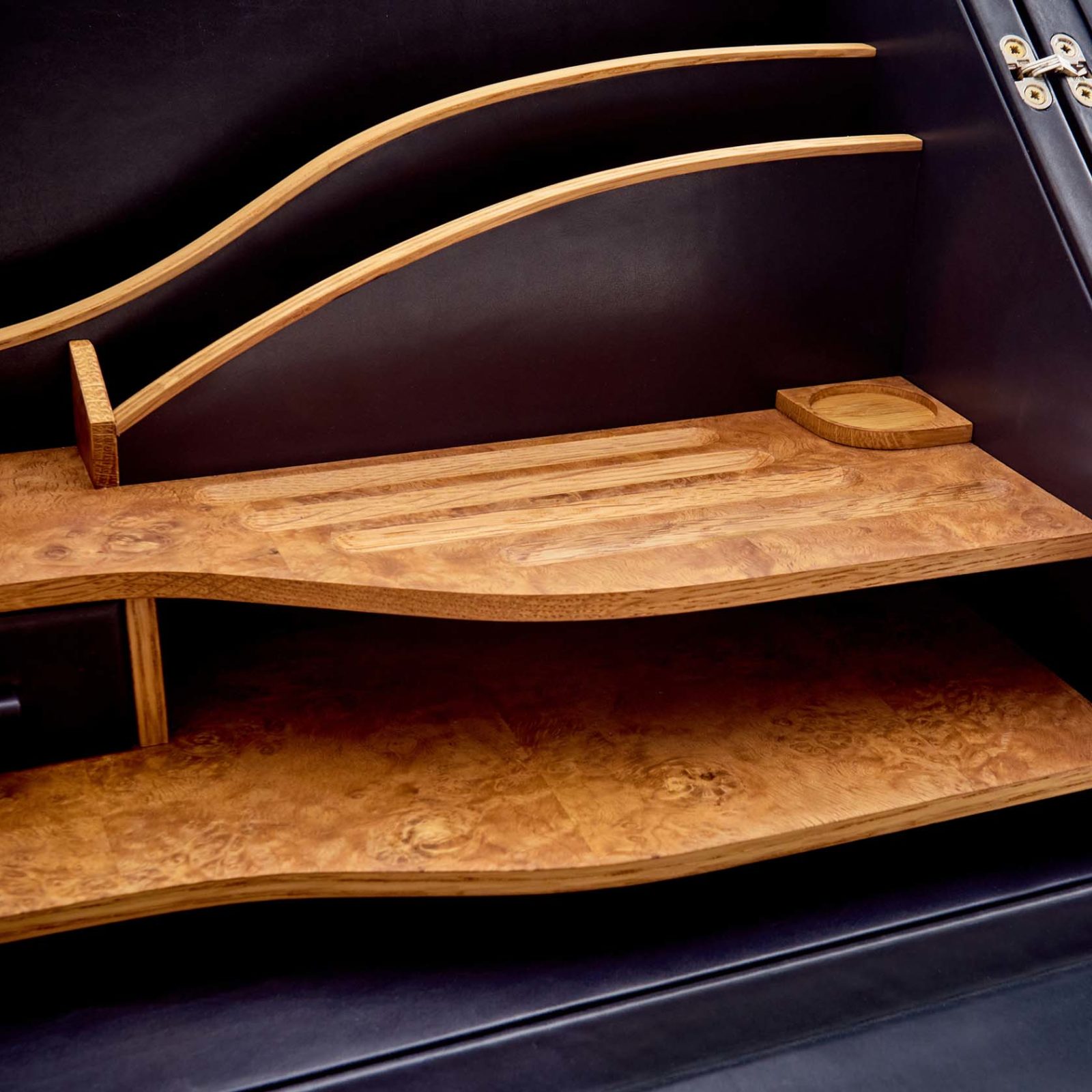 Burr oak and leather stationery bureau
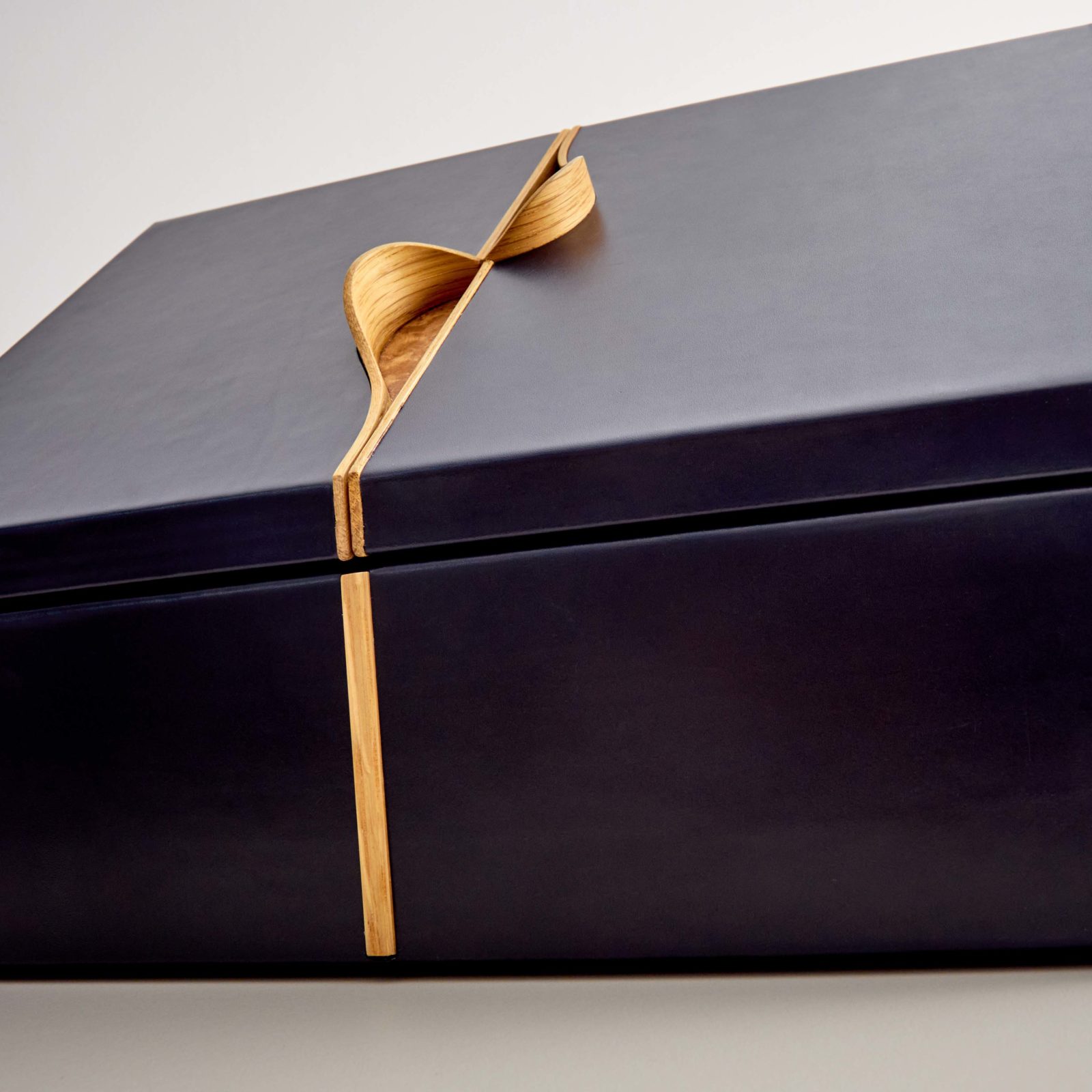
“Now I feel duty bound to share what I know and contribute to the creation of a thriving leather industry.”
For if there are not the industrial opportunities for mass-production, Denise has shown that there is by contrast a strong demand for excellent creative hand-skills, in an ever-growing bespoke and luxury sector, where craftsmanship combined with ethically sourced materials can command high premiums. In this sector, leather is a primary material, with expert handling critical to bringing out the qualities that make it so alluring. To this end, Denise explains that she wants to instill in young students not just first-rate technical leather-working skills but a fully rounded understanding of and respect for leather. “From it coming through the door, understanding what you are looking at. Checking quality, pressure marks, growth scars and knowing how to wrap, store and label it,” Denise explains. She sums up: “I came in at a time when you could just about sense the scale of the industrial leatherworking of the past, but things had rapidly changed. No one could give me the job I wanted, so I had to create it myself. Now I feel duty bound to share what I know and contribute to the creation of a thriving leather industry. We have the support from industry and institutions – we should be incredibly ambitious – our heritage and innate connection to this material demands nothing less.” Having pioneered a contemporary career, she is now helping the industry evolve in a new context, where excellence is all. If there are the students to pursue it, and teachers prepared to instruct them, there is undoubtedly a market to support their skills.
READ MORE
Anya Hindmarch: Fashion with purpose
Fashion journalist Emily Cronin explores the career and inspirations of Dame Anya Hindmarch.
Alistair Tusting: Honouring the natural beauty of leather is core to what we do
Tusting CEO Alistair discusses his design philosophy and explains why a leather bag will never let you down. As told to journalist Emily Cronin.
The hides that bind
The versatile and sustainable qualities of leather are helping talented craftspeople access, develop, and sustain careers in artisanal fashion.